| Head arrangement method | Counterpart arrangement |
| Structural form | Adjustable at both ends, flat chamfered at both ends of the steel pipe |
| Number of tool holders on the cutterhead | Single head 2 (flat head 1, chamfered edge 1) |
| Knife holder form | Floating chamfered tool holder, profiling inside the roller |
| Speed regulation method | Mechanical transmission combined with AC motor speed regulation, continuously variable speed |
| Headbox feeding method | Motor feed |
| Transportation method | Automatic hydraulic pickup and delivery device |
| Steel pipe clamping method | hydraulic clamping |

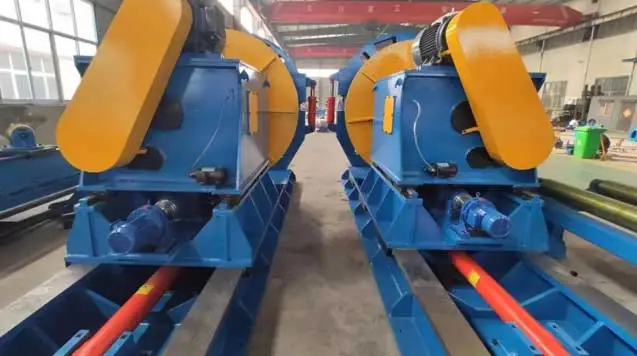
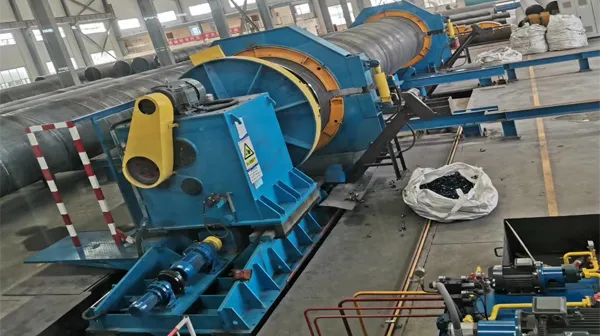
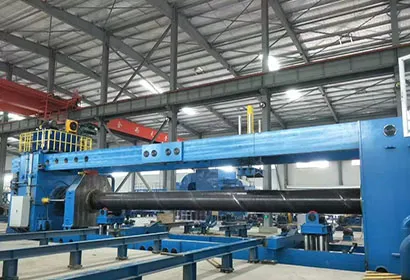
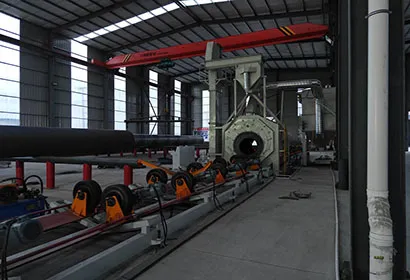
This pipe chamfering equipment is a symmetrical arrangement of units: two symmetrical main machines are installed on sliding seats at both ends, and two steel pipe lifting devices are placed on the centerline of the main machine. The host is composed of a fixed base, a sliding seat, a headstock, a cutterhead, a steel pipe clamping device, etc. The equipment outside of the host includes a steel pipe lifting device, hydraulic system, and electrical system.
1. Sliding seat
The sliding seat is composed of a track, a main body, a sliding plate on the main body, and a transmission system, and is installed on a fixed base. The main body is an integral structure, made of high-quality carbon steel welded structural components with sufficient strength and stiffness. The guide rail is linear, with low wear and high accuracy.
2. Headbox
The headbox is the transmission component of the cutterhead.
The headstock is installed on a sliding seat, and is a welded structural component. The spindle adopts a structural form commonly used in general precision machine tools, with high accuracy and rigidity.
The front end of the host is equipped with a cutter head, and two cutter heads are symmetrically arranged on the front end face of the cutter head. The cutter head can move radially along the center of the cutter head to adapt to processing of different pipe diameters. After the tool table is moved to the appropriate position, it is fixed with screws. There is a floating tool seat on the tool table, which is positioned by the roller using the inner diameter of the steel pipe for profiling processing. A dedicated tool holder is fixed on the tool holder, and a standard blade is installed on the tool holder.
3. Steel pipe clamping device
The steel pipe clamping device is used to clamp the steel pipe when processing the end face. The steel pipe clamping device is installed near the base and the front end of the cutter head. Use two hydraulic cylinders to simultaneously operate on both sides of the clamping device. The clamping module is a circular module, and different pipe diameters can use integral blocks or combination blocks. The clamping fixture of this machine adopts a welding structure, saving time for replacing specifications.
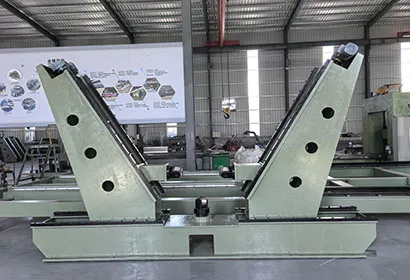
4. Steel pipe lifting device
Two sets of steel pipe V-shaped lifting frames are installed in front of each bed. The V-shaped lifting frame is driven by an oil cylinder and guided by a guide column. The lifting of the steel pipe V-shaped lifting frame is basically synchronized and controlled. The lifting height is manually adjusted when changing specifications (proximity switch limit control). When in custody, the two support frames should be able to lift the steel pipe. When the clamping device clamps the pipe, the support oil cylinder is depressurized to center the steel pipe according to the clamping device, and the support frame serves as an auxiliary support, Prevent deformation and vibration of steel pipes.
The pipe is pushed forward → the pipe is taken over by the pipe puller → the V-shaped idler roller of the lifting device is raised → the steel pipe is lowered to the upper part of the cutting center → the end of the steel pipe is moved to a distance of 100mm from the end of the pipe → the steel pipe is dropped on the clamping device and clamped at the same time → Bedside box starts → fast forward → work forward → flat end chamfering → fast reverse → clamping open → steel pipe rises above the cutting center → steel pipe exits away from the cutter head → steel pipe is placed on the table → pulled out by the pipe puller Steel pipe → to the next cycle