English
×
Search
A spiral welded pipe mill is an integrated production system designed to continuously manufacture steel pipes by forming a steel strip into a helical shape and welding the spiral seam. Compared with conventional straight-seam production, a spiral mill can produce different pipe diameters by adjusting the forming conditions and using steel strips with different widths.
For manufacturers planning a new spiral welded steel pipe factory, understanding the complete equipment configuration is essential. A production line is not simply a forming machine and a welding unit. It typically includes material preparation, feeding, forming, welding, cutting, control, hydraulic and auxiliary systems, as well as downstream testing and finishing equipment.
TianxiangHao provides complete spiral welded pipe production line solutions, with configurations available for large-diameter, small-diameter, heavy-duty, thin-wall and stainless-steel applications.
A spiral pipe mill is a continuous manufacturing line that converts steel coils or strips into cylindrical pipes through helical forming and welding. During the spiral steel pipe manufacturing process, the strip enters the line continuously, is leveled and aligned, and then passes through forming equipment that gradually bends it into a cylindrical shape.
The edges of the formed strip are welded together to create the spiral seam. Depending on the pipe specification and line configuration, internal and external welding systems can be used.
The main advantage of this manufacturing principle is flexibility. A spiral welded pipe mill can manufacture pipes with different diameters using strips of the same width, while different strip widths can also be used to achieve the required pipe diameter.
For pipeline applications, manufacturers should also consider applicable product standards. For example, API Specification 5L establishes requirements for the manufacture of seamless and welded steel pipe used in petroleum and natural-gas pipeline transportation systems. The American Petroleum Institute published the 47th edition in June 2026.
The basic spiral welded pipe process can be summarized as:
Uncoiling → Leveling → Steel Coil Alignment → Butt Welding → Feeding → Edge Milling → Feeding → Guiding → Spiral Forming → Welding → Pipe Diameter Inspection → Cutting → Pipe Output
The exact process varies according to pipe diameter, wall thickness, steel grade, welding method and production requirements.
The process begins with a steel coil loaded onto an uncoiler. The uncoiler continuously releases the strip into the production line at a controlled speed.
Stable coil feeding is important because fluctuations in strip tension can affect subsequent forming and welding operations.
The steel strip passes through a pinch leveler to reduce unwanted deformation and improve flatness. Electric vertical rollers then guide and center the strip.
This stage helps maintain consistent strip positioning before it reaches the forming section.
When one coil is nearly finished, the end of the current strip can be joined to the beginning of the next coil using a shear butt welding machine.
This continuous joining operation reduces production interruptions and supports continuous spiral pipe manufacturing.
The prepared strip enters the guide and forming section. A forming machine bends the strip progressively into a cylindrical shape.
The forming angle is an important parameter because it influences the relationship between strip width and finished pipe diameter. Therefore, forming equipment must provide sufficient adjustment capability for different production specifications.
Once the strip edges are brought together, the longitudinal edges are welded along the helical seam.
For heavy-duty configurations, TianxiangHao's equipment composition can include both internal welding devices and external welding devices, together with submerged arc welding machines.
The welding system is one of the most important components of the entire spiral pipe welding line because seam integrity directly affects the performance of the finished pipe.
After the pipe reaches the specified length, a cutting trolley or flying cutting system cuts the produced pipe continuously.
The finished pipe is then removed from the forming section and transferred for inspection, end finishing, hydrostatic testing, coating or other downstream operations.
A complete steel welded pipe making mill normally combines several equipment groups rather than relying on one machine.
| Equipment | Main Function | Importance in the Line |
|---|---|---|
| Uncoiler | Loads and supports steel coil | Continuous material supply |
| Pinch Leveler | Corrects strip flatness | Improves forming stability |
| Electric Vertical Rollers | Centers and aligns strip | Controls strip position |
| Shear and Butt Welding Machine | Joins successive strips | Supports continuous production |
| Delivery Machine | Transfers strip toward forming | Maintains stable feeding |
| Guide Plate | prevents the steel strip from bending or bulging before entering the forming machine. | Controls entry position |
| Forming Machine | Forms strip into a spiral pipe | Core forming equipment |
| Internal Welding Device | Welds the internal spiral seam | Creates primary seam integrity |
| External Welding Device | Welds the outer seam | Supports complete seam welding |
| Centralizer | Supports pipe positioning | Improves dimensional stability |
| Cutting Trolley/Flying Cutter | Cuts pipe to required length | Determines finished pipe length |
| Hydraulic System | Powers relevant mechanical movements | Provides controlled operation |
| Electrical Control System | Controls line operation | Coordinates the production process |
| Welding Machines | Provide welding power | Supports seam welding |
| Plasma Cutting Machine | Performs cutting operations | Enables efficient pipe separation |
| Air Compressor | Supplies compressed air | Supports auxiliary equipment |
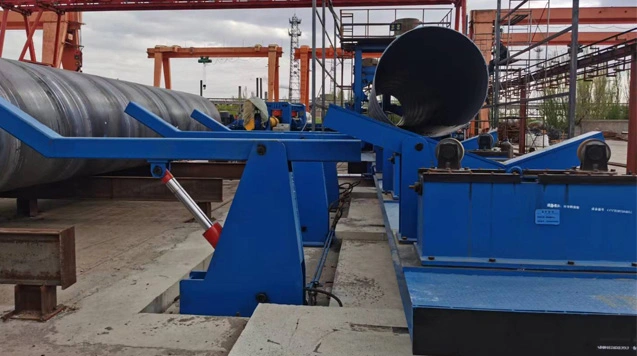
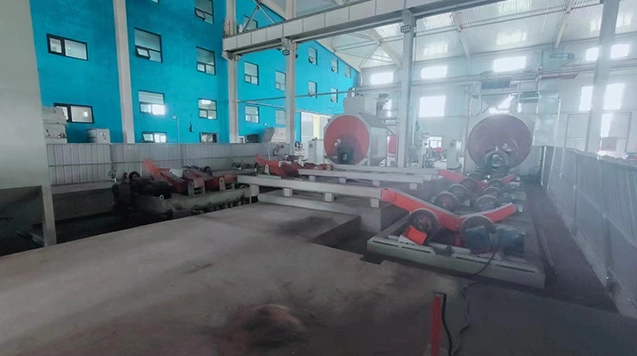
TianxiangHao's published equipment configurations show that the exact equipment list depends on the production line type. For example, its front-swing line includes an uncoiler, head removal machine, pinch leveler, electric vertical rollers, edge milling machine, delivery machine, forming machine, internal and external welding devices, centralizers, cutting trolley, hydraulic station, electrical control system and welding equipment.
A complete spiral welded pipe factory usually needs main forming and welding equipment. Finished pipes may require several downstream operations depending on the intended application.
Hydrostatic testing can be used to evaluate the pressure resistance and integrity of finished steel pipes. For manufacturers producing pipes for demanding pipeline applications, testing equipment should be selected according to the required pipe dimensions and applicable standards.
TianxiangHao offers dedicated steel pipe hydrostatic pressure testing machines for different pipe sizes and pressure requirements.
After cutting, pipe ends may require beveling or chamfering before transportation, welding or pipeline installation. A dedicated steel pipe beveling machine can provide controlled end preparation.
Non-destructive testing can be incorporated into a modern spiral welded steel pipe factory to identify potential internal or weld-related defects without damaging the pipe.
For pipeline products, inspection requirements should be established according to the applicable specification and customer requirements. API's current API 5L framework includes manufacturing, inspection, testing, marking and traceability requirements.
When selecting equipment for a new spiral steel pipe factory, buyers should evaluate the complete production requirement rather than focusing only on the machine price.
Important factors include:
Pipe diameter range – Determine the minimum and maximum finished pipe diameter.
Wall thickness – Heavy-wall applications require stronger forming and welding capabilities.
Steel grade – Material properties affect forming and welding requirements.
Production capacity – Match line speed with annual production targets.
Welding method – Select internal, external or double-sided welding according to product requirements.
Automation level – Consider automatic feeding, welding, cutting and process control.
Testing requirements – Plan hydrostatic, ultrasonic, X-ray and dimensional inspection equipment where required.
Future product range – A flexible line can be more valuable when a manufacturer expects to produce multiple pipe specifications.
For pipeline transportation applications, ISO 3183:2019 specifies requirements for PSL 1 and PSL 2 seamless and welded steel pipes used in petroleum and natural-gas pipeline transportation systems.
Purchasing a complete spiral welded pipe manufacturing system offers advantages in equipment compatibility, process integration and commissioning.
The forming machine, welding equipment, cutting system, hydraulic system and electrical control system must operate as one coordinated production process. If individual machines are purchased independently, differences in mechanical specifications or control systems can create integration challenges.
A complete-line supplier can design the equipment around the customer's target pipe range, production capacity and manufacturing process.
TianxiangHao specializes in the design and manufacture of steel pipe production equipment and can provide complete production-line solutions, including spiral welded pipe lines, hydrostatic testing machines, chamfering machines, and pipe inspection equipment.
TianxiangHao, also known as TXH, focuses on spiral welded pipe production line and related steel pipe manufacturing equipment. Its product range includes large-diameter, small-diameter, heavy-duty, thin-wall and stainless-steel spiral pipe lines.which is widely used in oil,gas and pipeline transmission .TXH company focus on fully automatically product which strictly comply with API standard.
The company also provides supporting equipment such as hydrostatic pressure testing machines, steel pipe chamfering machines, ultrasonic testing equipment and X-ray inspection equipment.
This broader equipment allows customers to plan a more integrated production system rather than sourcing every process from a different supplier.
A spiral pipe mill is a continuous production line that forms steel strip into a helical cylindrical shape and welds the edges to manufacture spiral welded steel pipe.
The core equipment generally includes an uncoiler, leveler, vertical rollers, shear and butt welding machine, edge milling machine, delivery machine, guide system, forming machine, welding equipment, centralizer and cutting system. Hydraulic and electrical control systems are also required.
The typical process includes uncoiling, leveling, alignment, butt welding, edge milling, feeding, guiding, spiral forming, seam welding, cutting and finished-pipe output. Additional inspection processes may follow.
Yes. One of the advantages of spiral pipe manufacturing is its flexibility in producing different pipe diameters by adjusting forming conditions and using steel strips of appropriate widths.
Not necessarily. Testing equipment can be configured as part of the complete project according to product requirements. Hydrostatic testing, ultrasonic inspection and X-ray inspection are common downstream options.
The applicable standard depends on the intended application, product specification and customer requirements. For oil and gas pipeline applications, API Specification 5L and ISO 3183 are important references.
A spiral welded pipe mill is a coordinated manufacturing system rather than a single machine. From uncoiling and leveling to forming, spiral welding, cutting and finished-pipe handling, every section contributes to production efficiency and pipe quality.
For a new spiral welded pipe factory, the most effective approach is to define the target pipe diameter, wall thickness, steel grade, production capacity, welding requirements and testing standards first. The complete equipment configuration can then be designed around these requirements.
Covering spiral pipe production lines and supporting equipment, TianxiangHao can provide integrated solutions for manufacturers looking to establish or upgrade a spiral steel pipe manufacturing facility.