English
×
Search
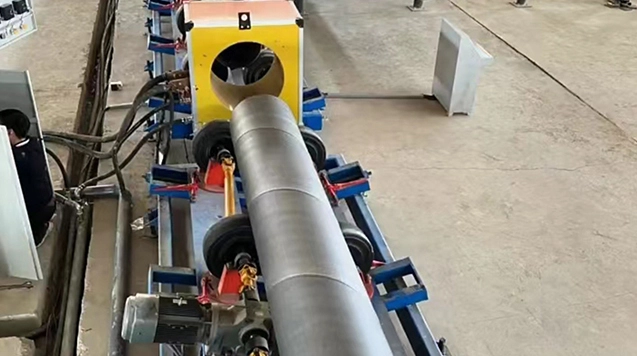
A steel pipe chamfering machine is used to prepare the ends of steel pipes after cutting and other primary manufacturing operations. It removes unwanted material from the pipe end, creates a specified bevel, and can improve the consistency of the finished pipe before inspection, coating, transportation, or field welding.
For a spiral welded pipe mill, end preparation is an important finishing operation. After the spiral pipe manufacturing process produces pipes to the required length, the pipe ends may need to be faced and beveled to achieve the required geometry.
A modern facing and chamfering machine combines controlled pipe positioning, clamping, cutting and end machining into one production stage. Depending on pipe specifications and production requirements, the system can be designed for manual, semi-automatic or fully automatic operation.
A pipe end chamfering machine is industrial equipment designed to machine the ends of steel pipes. Its primary functions are facing and chamfering.
Facing removes uneven material from the pipe end to create a more uniform end surface.
Chamfering removes material at a specified angle around the pipe edge, creating a bevel that can facilitate subsequent joining or welding operations.
For pipeline products, end geometry can be an important part of product quality. ISO 3183, for example, covers steel pipe used in petroleum and natural-gas pipeline transportation systems and includes requirements relevant to pipe manufacture and delivery.
The exact geometry depends on pipe diameter, wall thickness, application, welding method, and applicable specifications. For example, ASME B16.25 covers the preparation of butt welding ends and includes requirements related to welding bevels, internal and external shaping, dimensions, and tolerances.
Although machine designs differ, the operating principle of an automatic steel pipe chamfering machine can be divided into several stages.
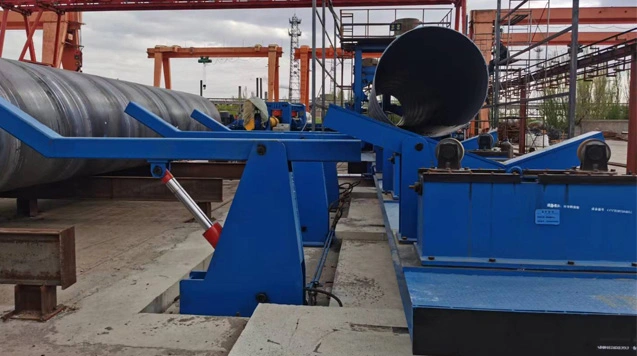
The finished pipe is transferred from the previous production or handling station to the chamfering area.
Depending on the line configuration, rollers, conveyors or other handling mechanisms position the pipe before machining.
Correct positioning is essential because the machining tools must remain aligned with the pipe axis. Poor positioning can result in uneven bevel dimensions or inconsistent end faces.
Once the pipe reaches the machining position, a clamping system secures it.
The clamping mechanism must provide sufficient holding force without causing unacceptable deformation. This is particularly important when processing large-diameter or thin-wall pipes.
The machine may use mechanical, hydraulic or pneumatic clamping depending on the pipe size and automation level.
After clamping, the cutting head moves toward the pipe end.
The facing tool removes irregularities and creates a relatively flat end surface. This operation establishes a consistent reference surface for subsequent beveling.
For spiral welded pipes, maintaining the correct pipe-end geometry is important because the product may later undergo inspection, coating or connection with another pipe.
After facing, the cutting tool produces the specified bevel.
The bevel angle, depth and root-face dimensions depend on the required pipe-end design.
A pipe chamfering machine can therefore be configured with different tooling arrangements to accommodate different end-preparation specifications.
The objective is not simply to remove material. The finished end needs to meet the dimensional requirements established for the product.
Once machining is complete, the cutting tools retract and the clamping system releases the pipe.
The finished pipe can then be transferred to the next station for inspection, coating, stacking or transportation.
In an automated line, sensors and control systems can coordinate these movements to reduce manual intervention and improve production consistency.
Facing and chamfering are related but different operations.
| Operation | Main Purpose | Typical Result |
|---|---|---|
| Facing | Corrects the pipe-end surface | More uniform end face |
| Chamfering | Creates an angled edge | Specified bevel |
| Beveling | Produces a controlled weld-preparation profile | Suitable pipe-end geometry |
| Cutting | Separates pipe to required length | Finished pipe section |
A facing and chamfering machine may perform both operations in one machining cycle.
This combination can be more efficient than transferring the pipe between separate machines, particularly for production lines handling large quantities of steel pipe.
In a spiral welded pipe mill, the pipe is continuously formed and welded before being cut into individual sections. Once the pipe reaches its required length, the ends may have to undergo additional finishing.
This makes the pipe end chamfering machine a downstream companion to the main spiral production line.
Proper end preparation can provide several benefits:
More consistent pipe-end dimensions
Better preparation for field or factory welding
Improved appearance of finished products
Reduced manual grinding
More repeatable production
Easier integration with downstream handling
For pipeline applications, consistent pipe-end preparation can be particularly important because pipes may subsequently be joined into long pipeline systems.
A simplified production relationship is:
Steel Coil → Spiral Forming → Spiral Welding → Cutting → End Facing & Chamfering → Inspection → Coating/Finishing → Storage
The actual arrangement depends on the plant layout.
The chamfering operation normally takes place after pipe cutting because the machine is designed to process the ends of individual pipe sections.
It can also be integrated with other finished-pipe equipment such as hydrostatic testing and nondestructive inspection systems.
This creates a complete downstream processing chain:
Pipe Cutting → Chamfering → Hydrostatic Testing → NDT → Coating
Not every factory uses exactly this sequence. Inspection and end preparation may be arranged differently according to production requirements.
Companies comparing chamfer machine manufacturers should evaluate the machine against the actual pipe specifications rather than focusing only on machining speed.
The machine must accommodate the full product range. Large-diameter pipes and thin-wall pipes can require different clamping and tooling configurations.
The machine should produce consistent end-face and bevel dimensions across repeated production cycles.
An automatic chamfering machine can reduce manual handling and improve production efficiency when integrated into a high-volume pipe manufacturing line.
Cutting tools should be suitable for the steel grade and pipe dimensions. Tool accessibility and replacement time can also affect production efficiency.
The machine should communicate effectively with upstream cutting and downstream handling systems.
For a spiral welded pipe factory, this can be more valuable than purchasing a high-speed standalone machine that cannot integrate efficiently with the existing production line.
A complete steel pipe finishing section may include several complementary machines.
| Equipment | Function |
|---|---|
| Pipe cutting machine | Cuts pipe to the specified length |
| Pipe chamfering machine | Machines pipe ends |
| Hydrostatic tester | Tests pressure integrity |
| Ultrasonic inspection system | Detects selected internal or surface imperfections |
| X-ray inspection system | Examines certain weld imperfections |
| Pipe expander | Corrects or controls pipe-end geometry |
| Coating equipment | Applies protective external layers |
These systems perform different functions and should not be treated as interchangeable.
For example, an X-ray system examines weld quality, while a tube chamfer machine physically removes material from the pipe end. Hydrostatic testing evaluates pressure integrity. Combining these technologies provides a more complete approach to finished-pipe quality control. End machining is a dimensional and surface-preparation process, while radiographic inspection serves a different purpose: it can be used to examine welded areas for internal imperfections. ISO 10893-6 specifies radiographic testing of the weld seam of welded steel tubes, so X-ray inspection can be positioned downstream of pipe forming and welding as part of the overall quality-control process.
For manufacturers operating a spiral welded pipe mill, TXH can provide pipe end-processing equipment as part of a broader steel pipe machinery solution.
TXH's steel pipe chamfering machine is designed for pipe-end processing and can be considered together with other production-line equipment. This approach is useful for projects where the chamfering station needs to work with upstream pipe production and downstream testing.
For buyers, the main consideration should be whether the equipment configuration matches the required pipe diameter, wall thickness, production capacity and end-preparation specifications.
Rather than selecting a chamfering machine manufacturer solely by catalogue specifications, procurement teams should provide detailed product parameters and request a configuration based on the actual production environment.
For projects requiring customized equipment, buyers should prepare a technical specification sheet before contacting suppliers.
The specification should include:
Minimum and maximum pipe diameter
Wall thickness range
Steel grades
Pipe length
Required bevel angle
Required root-face dimensions
Production capacity
Automation requirements
Existing line layout
10.Downstream equipment
This information allows customized tube chamfering machines manufacturers to determine the appropriate clamping mechanism, tooling, drive system and control configuration.
For manufacturers processing several pipe sizes, flexibility can be more important than achieving the highest machining speed for a single specification.
A steel pipe chamfering machine machines the ends of steel pipes by removing material to create a flat end face and/or a specified bevel.
A pipe cutting machine separates the pipe into sections of a specified length, while a chamfering machine prepares the cut pipe ends for subsequent processing or joining.
Yes, depending on its design. The clamping system, tooling and adjustment range must be suitable for the required diameter and wall-thickness range.
It depends on the product specification and final application. For pipes that require specific end preparation for joining or welding, chamfering can be an important finishing operation.
Yes. It can be positioned downstream of the pipe cutting process and coordinated with pipe handling, inspection and other finishing equipment.
Provide the pipe diameter, wall thickness, steel grade, pipe length, required bevel geometry, production capacity and desired automation level.
A pipe end chamfering machine completes an important finishing operation after steel pipe production and cutting. By securing the pipe, machining the end face and producing a controlled bevel, it creates more consistent pipe-end geometry for subsequent inspection, coating, transportation or joining.
For a spiral welded pipe factory, the chamfering station should be considered as part of the downstream finishing system rather than as an isolated machine. When selected according to pipe specifications and integrated with cutting, testing and handling equipment, it can contribute to a more consistent and efficient production workflow.
TXH can be considered by manufacturers looking for pipe-end processing equipment that fits into a broader steel pipe production and finishing solution.