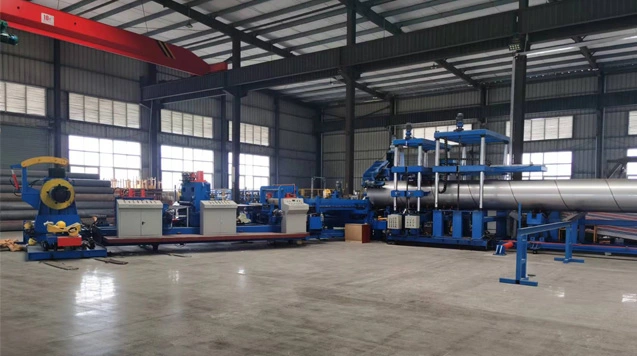
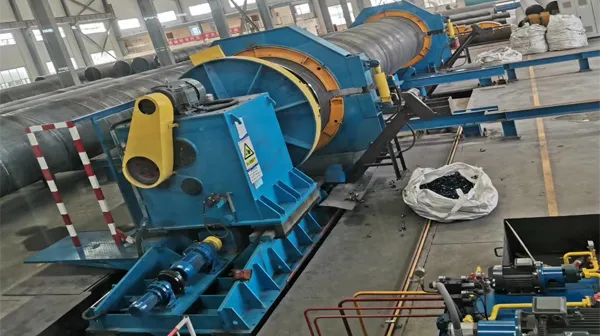
How Is Spiral Pipe Mill Production Capacity Calculated?
When purchasing a Spiral Pipe Mill, what matters most to you? Most likely, it comes down to two questions: How many steel pipes can this machine produce per hour? How many orders can it complete in a month?
The answer cannot be determined by the machine’s stated maximum speed alone. Different pipe specifications and production cycles lead to different output levels. More importantly, theoretical production capacity is not the same as the quantity of finished products that can actually be delivered.
This article explains how to calculate Spiral Pipe Mill production capacity step by step, starting with pipe weight and production cycle time. It also highlights the key data buyers should examine when selecting equipment.
What is Spiral Pipe Mill Production Capacity?
For a spiral welded pipe production line, production capacity refers to the volume of steel pipe that the equipment can manufacture within a given timeframe; this can be expressed in terms of tons per hour, meters per hour, or the number of pipes per hour.
However, theoretical capacity, actual capacity, and the yield of qualified finished products are not the same. Factors such as equipment operating speed, pipe specifications, time required for product changeovers, periods of downtime, and the results of quality inspections all influence the final output.
Therefore, when evaluating the capacity of a spiral pipe mill, one should not rely solely on the equipment's nominal speed. It is essential to clarify the units of measurement, the specific pipe dimensions, and the actual quantity of qualified steel pipe that can be delivered.
What Key Parameters Are Needed to Calculate Spiral Pipe Mill Production Capacity?
Pipe outside diameter and wall thickness: Used to calculate the theoretical weight per meter.
Individual pipe length: Used to calculate the weight of each pipe.
Production cycle time: The number of seconds required to complete one pipe, or the actual interval between finished pipes leaving the entire line.
Effective production time: The time actually available for production during a shift or reporting period.
Utilization factor and acceptance rate: Used to estimate actual output and the quantity of acceptable products.
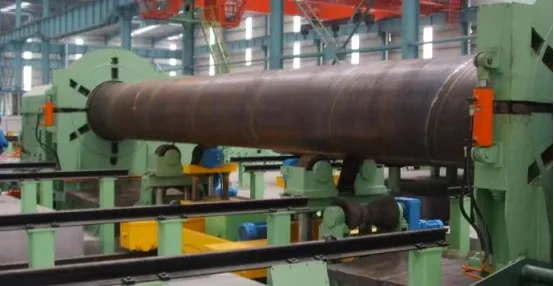
How Can Theoretical Production Capacity Be Calculated from Pipe Specifications and Production Cycle Time?
Theoretical production capacity can be estimated in three steps: calculate the pipe’s weight per meter, calculate the weight of each pipe, and then estimate hourly output based on the production cycle time.
For carbon steel pipes, the approximate weight per meter can be calculated using:
Weight (kg/m) = (Outside diameter − Wall thickness) × Wall thickness × 0.0246615
Multiply the result by the pipe length to get the weight per pipe. Then calculate hourly output:
Pipes per hour = 3,600 ÷ Production cycle time (seconds per pipe)
Tons per hour = Pipes per hour × Weight per pipe (tons)
For example, a pipe with an outside diameter of 1,220 mm, a wall thickness of 12 mm, and a length of 12 m weighs approximately 4.29 tons. Assuming a complete production cycle of 480 seconds per pipe, the theoretical output is 7.5 pipes per hour, or approximately 32.2 tons per hour.
This is a theoretical estimate, not a guarantee of actual production performance. The real output depends on pipe specifications, material, welding requirements, and the configuration and operating conditions of the complete production line.
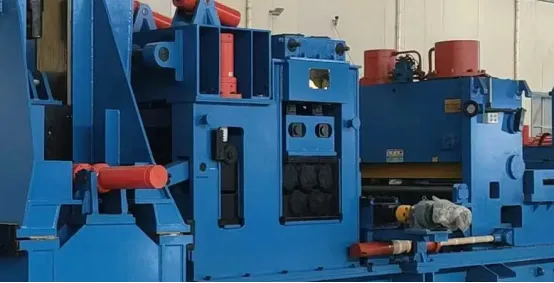
How Can Theoretical Production Capacity Be Converted into Actual Production Capacity?
Theoretical output does not account for production downtime or quality losses. To estimate actual output, apply the relevant time utilization and product acceptance factors, ensuring that losses are not counted twice.
Actual output = Theoretical output × Time utilization factor × Acceptance rate
For example, with a theoretical output of 32.2 tons/hour, a time utilization factor of 0.80, and an acceptance rate of 0.97, the estimated output is approximately 25.0 tons/hour. These factors are illustrative assumptions, not industry benchmarks.
The time utilization factor reflects effective production time, while the acceptance rate reflects the proportion of products meeting quality requirements. If output already represents accepted finished pipes, do not apply the acceptance rate again.
To estimate shift or monthly output, multiply the applicable hourly output by the planned production hours, using a consistent measurement basis.
What Factors Affect the Actual Output of a Spiral Pipe Mill?
The actual output of a spiral pipe mill depends on more than its maximum operating speed. Pipe diameter, wall thickness, material characteristics, and welding requirements can affect production speed. The Federal Reserve's explanation of industrial capacity utilization also highlights the importance of accounting for normal downtime when estimating sustainable output.
Downstream bottlenecks, equipment failures, product changeovers, maintenance, and material delays can further reduce production. The U.S. Census Bureau's plant capacity utilization survey distinguishes actual production from full production capability. Buyers should therefore evaluate whether the complete production line can consistently deliver acceptable pipes at their required specifications, rather than relying solely on the main machine’s maximum speed.
Case Showing: How TXH Configures Spiral Pipe Mills for Different Production Needs
Choosing a spiral pipe mill is not simply about selecting the machine with the highest stated speed. The production line must match the required pipe diameter, wall thickness, target output, and operating conditions. TXH provides spiral pipe mill configurations for different pipe manufacturing requirements, with project examples such as its spiral pipe mill installation in Bangladesh. For buyers planning a new facility or upgrading an existing line, reviewing project specifications can help clarify which equipment configuration may suit their production goals.
FAQs
1. What Is the Difference Between Theoretical and Actual Spiral Pipe Mill Production Capacity?
Theoretical capacity is calculated from the specified production cycle. Actual capacity also accounts for downtime, product changeovers, and operating efficiency. If you need to know the quantity that can ultimately be delivered, you should also consider acceptable product output.
2. What Utilization Factor Should Be Used When Calculating Actual Production Capacity?
There is no single fixed value that applies to every spiral pipe mill machine. The factor should ideally be based on the supplier’s verified performance data or the factory's actual production records. If such data are unavailable, an explicitly identified assumption can be used for preliminary estimation, but it must not be treated as an industry standard.
3. How Can Buyers Verify a Supplier's Production Capacity Figures When Purchasing a Spiral Pipe Mill?
First, confirm the pipe specifications, materials, process conditions, and measurement units associated with the quoted capacity. Then agree on a test using representative product specifications. The test duration, acceptance criteria for finished pipes, and output calculation method should be clearly defined, with key indicators incorporated into the technical agreement.
References / External Resources
Federal Reserve's explanation of industrial capacity utilization
https://www.federalreserve.gov/releases/g17/capnotes.htm
U.S. Census Bureau's plant capacity utilization survey