English
×
Search
A pipe chamfering machine prepares the ends of steel pipes by creating controlled chamfers, bevels, or end-face profiles before welding, threading, coating, or further processing. For steel pipe manufacturers, the right machine can improve end preparation continuity, reduce manual finishing, and support faster production.
However, there is no universal pipe chamfering machine price. Equipment cost depends on pipe diameter, wall thickness, pipe length, end-processing requirements, production capacity, automation level, tooling, and whether one or both pipe ends need to be processed meanwhile.
For buyers comparing schemes, the most important question is not simply “How much does the machine cost?” but rather “Which configuration can achieve the required end quality and production output with reasonable operating costs?”
Several technical factors have a direct effect on equipment price.
The first is pipe diameter and wall thickness. A machine designed for small, thin-wall pipe requires less clamping force and structural rigidity than equipment processing large-diameter, heavy-wall steel pipes. Larger workpieces also require stronger feeding, positioning, lifting, and supporting systems.
The second factor is the required end profile. Some production lines only need a simple chamfer, while others require beveling, facing, or a combination of outside bevel, inside bevel, and end face preparation. More complex profiles may require different cutter heads, tool holders, control functions, and machining power.
Production speed is another major consideration. A low-volume plant may accept a simpler single machine, while a high-output pipe mill may need automatic feeding and double-end processing to reduce cycle time.
Automation also affects investment. PLC-controlled loading, centering, clamping, machining, unloading, and line communication increase begin cost, but they can improve production consistency and reduce operator intervention.
The suitable configuration depends on pipe dimensions, production volume, and the required end-finishing process.
| Configuration | Best Suited For | Main Advantages | Key Buying Considerations |
| Single-End Chamfering Machine | Small batches or flexible production | Lower initial investment and simpler operation | Longer cycle time when both ends require machining |
| Double-End Chamfering Machine | Medium- to high-volume pipe production | Processes both pipe ends efficiently and improves output | Requires accurate pipe positioning and synchronization |
| Automatic Chamfering Line | Continuous production lines | Automated loading, centering, machining and unloading | Higher investment and greater integration requirements |
| Large-Diameter End Facing & Beveling Machine | LSAW, SSAW and large structural pipes | Suitable for heavy pipes and needing bevel profiles | Frame strength, clamping force and pipe handling become important |
| Multi-Profile Chamfering System | Plants producing multiple pipe specifications | Greater flexibility for different chamfer and bevel requirements | Tool change time and configuration flexibility should be evaluated |
The lowest-cost machine is not always the most economical choice. If production output is high, labor-intensive loading or single-end processing can create a bottleneck that increases the long-term cost of every finished pipe.
Before asking a supplier for pricing, buyers should prepare the main production parameters.
These normally include:
Minimum and maximum pipe outside diameter
Wall thickness range
Pipe length
Pipe material and grade
Required chamfer or bevel angle
End face or land requirement
Inside and outside chamfer requirements
Whether one or both pipe ends need machining
Required production capacity
Pipe end condition before machining
Feeding and unloading method
Required automation level
Available workshop layout
Electrical standard
The more complete this information is, the easier it is for the supplier to choose the right machine frame, shaft power, cutter head, clamping mechanism, feeding system, and controls.
A quotation based only on pipe diameter can be misleading because two factories processing the same diameter may have very different wall thicknesses, bevel requirements, and hourly output objectives.
Larger and heavier pipes require more than a larger machining range.
The machine must support and position the pipe accurately while maintaining stable cutting conditions. If the workpiece is not right centered or fixed clamped, the resulting bevel may vary around the circumference.
Heavy-wall pipes also place greater demand on cutting power and tooling. Material grade, wall thickness, cutting depth, bevel angle, and required surface finish all influence machining load.
When evaluating a pipe chamfering machine, buyers should therefore compare the complete operating range rather than looking only at maximum pipe diameter.
For plants producing all kinds of specifications, it is also important to ask how quickly the machine can be adjusted between sizes. A wide theoretical processing range offers limited value if every changeover requires wide manual adjustment.
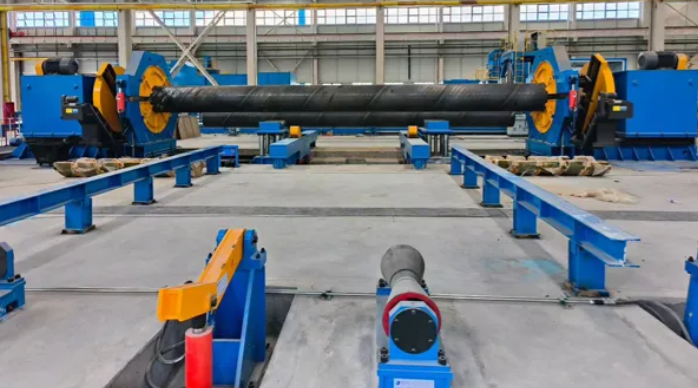
A single-end machine usually has a simpler structure and lower initial investment. It can be suitable for small production volumes, special pipe sizes, or factories where flexibility is more important than cycle speed.
A double-end machine processes both pipe ends within the same production sequence. This configuration is generally more suitable for higher-volume steel pipe production because it can reduce handling and improve cycle efficiency.
However, a double-end configuration requires more precise centering and synchronization. Buyers should compare not only machining time but the complete cycle:
Loading → Positioning → Clamping → Machining → Tool Retraction → Unclamping → Unloading
This total cycle determines actual production capacity.
For a continuous pipe mill, the chamfering machine should also be evaluated against upstream and downstream equipment. A machine that produces an excellent bevel but operates significantly slower than the rest of the line may become a production bottleneck.
Tooling is one of the most important areas to discuss before purchase.
Different customers may require:
Outside chamfering
Inside chamfering
End facing
V-bevel preparation
Combined inside and outside bevels
Controlled root face dimensions
The machine configuration should match the required finished geometry rather than forcing operators to perform secondary manual processing.
Ask the supplier how cutters are changed, how bevel angles are adjusted, what tool materials are recommended, and how long typical tooling lasts under your production conditions.
For factories processing several steel grades, tooling recommendations may vary because cutting behavior and tool wear can differ significantly.
The machine itself is only one part of a productive chamfering station.
Pipe loading, transfer, positioning, centering, clamping, and unloading can consume a significant portion of the cycle. This becomes particularly important as pipe diameter and weight increase.
Automatic conveyors and lifting mechanisms can reduce manual handling and help maintain consistent pipe positioning. Sensors and PLC controls can also coordinate the chamfering station with other equipment in the production line.
For high-volume projects, buyers should ask whether the supplier can provide:
Automatic pipe feeding
Centering devices
Lifting and supporting mechanisms
Automatic clamping
PLC recipe management
Diameter changeover assistance
Safety interlocks
Connection with existing conveyors
The correct automation level depends on production volume and labor conditions. Full automation may not be necessary for every factory, but insufficient handling equipment can limit the performance of an otherwise capable machine.
A detailed RFQ allows suppliers to provide a more accurate price and reduces unnecessary revisions later.
Before requesting a quotation, prepare the following information:
Pipe OD range: minimum and maximum outside diameter.
Wall thickness range: especially the maximum thickness.
Pipe length: minimum, maximum, and standard production length.
Pipe material: carbon steel, stainless steel, alloy steel, etc.
Required end profile: chamfer, bevel, facing, or combination.
Bevel angle: including tolerance requirements.
Root face dimensions: if applicable.
Single-end or double-end processing.
Target production rate: pipes per hour or required cycle time.
Automation requirement: manual, semi-automatic, or automatic.
Pipe handling requirement: conveyors, lifting, loading, and unloading.
Factory layout: available installation space and line direction.
Power supply: voltage and frequency.
Destination country: useful for electrical standards, shipping, and service planning.
Providing drawings or sample pipe specifications can further improve quotation accuracy.
There is no fixed price for industrial pipe chamfering equipment. Cost depends on pipe size, wall thickness, machining profile, production capacity, tooling, automation level, and pipe handling requirements.
Chamfering generally removes or shapes the sharp edge of a pipe end, while beveling typically produces a defined angled surface for welding preparation. Some industrial machines can perform chamfering, beveling, and end facing within the same machining process.
Yes. Industrial machines can normally cover a specified diameter range, but buyers should confirm changeover procedures, tooling requirements, centering methods, and adjustment time.
For high-volume production, double-end processing can significantly improve efficiency because both pipe ends are machined within one production sequence. For lower-volume or highly flexible production, a single-end configuration may offer a more economical solution.
At minimum, provide pipe OD, wall thickness, length, material, required end profile, bevel angle, production capacity, and desired automation level.
A meaningful price comparison should be based on the same pipe range, finished end profile, production capacity, automation scope, and handling requirements—not simply the machine's maximum diameter.
If you are planning a new steel pipe production line or upgrading an existing end-finishing station, provide your pipe specifications, bevel requirements, target output, and workshop layout through the inquiry form. TXH can then recommend a suitable machine configuration and prepare a technical quotation based on your actual production requirements.