What Is the Role of the Uncoiler, Leveler, Edge Milling Machine and Forming Machine in a Spiral Pipe Mill?
SSAW pipe manufacturing is a systematic process spanning material preparation, continuous forming, welding, in-line inspection, cut-to-length, and finished-pipe inspection. On an automated line, each machine has a specific function, and coordination between operations directly affects production stability, dimensional accuracy, and weld quality.
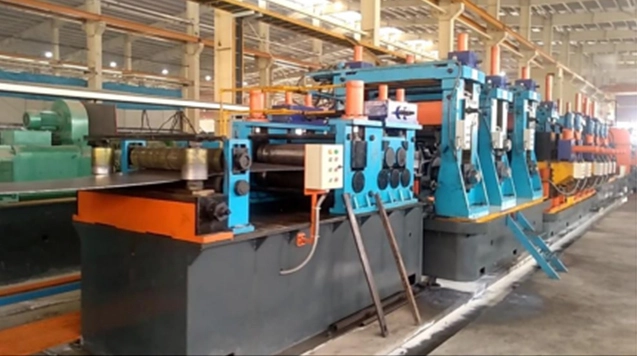
The uncoiler releases raw material at a controlled rate, the leveling machine improves strip flatness, edge milling prepares the strip edges, and the forming machine continuously rolls the strip into a spiral at the target diameter.
These 4 machines do not alone determine finished-pipe quality; their accuracy must work with raw material quality, feeding systems, welding, inspection, and downstream processing.
Complete SSAW Pipe Production Process
Production stage | Main operations | Primary objective |
Raw material preparation and pretreatment | Uncoiling, strip-end joining, strip accumulation, leveling, edge trimming or milling, surface cleaning, and edge pre-bending | Maintain continuous strip feeding and prepare the material for forming and welding |
Forming and welding | Strip feeding, spiral forming, weld gap and edge misalignment control, double-sided submerged arc welding, and post-weld cleaning | Form the specified pipe diameter and spiral weld seam |
In-line inspection and real-time monitoring | Weld nondestructive testing, automatic diameter measurement, and sizing when required | Detect welding or dimensional deviations promptly |
Cut-to-length and localized finishing | Flying or synchronized cutting, pipe-end beveling, or groove preparation | Produce pipes of the specified length with compliant pipe ends |
Finished-pipe inspection and post-processing | Repeat nondestructive testing, hydrostatic testing, expansion when required, dimensional and visual inspection, corrosion protection, marking, and packaging | Verify product quality and meet delivery requirements |
What Does an Uncoiler Do, and Why Is Stable Material Feeding Important?
An uncoiler supports and unwinds the steel coil at a controlled rate, ensuring a steady material supply to the production line.
The uncoiler must handle the coil’s weight, diameter, width, and thickness while matching line speed. Brakes, guides, and auxiliary feeders help maintain stable feeding.
During coil changes, strip joining equipment and an accumulator help keep production running. Continuous operation depends on the coordination of uncoiling, joining, accumulation, and feeding.
How Does a Leveling Machine Prepare Steel Strip for Downstream Processing?
As the steel strip passes through a series of staggered leveling rollers, it undergoes repeated controlled bending in alternating directions. This process reduces coil set, edge waves, and center buckles while helping redistribute residual stresses that could cause deformation during subsequent cutting, forming, or welding. According to the American Iron and Steel Institute (AISI), roller leveling works by bending the metal strip between offset upper and lower work rolls to improve flatness. Properly configured leveling helps the strip maintain a more consistent shape as it enters downstream equipment.
Why Are Edge Trimming and Milling Machines Important for SSAW Pipe Forming and Welding?
Edge trimming and milling machines are essential in SSAW pipe production because they remove irregular edges, burrs, and damaged material from steel strips before forming and welding. This preparation helps maintain consistent strip alignment and creates cleaner, more uniform edges for reliable spiral seam welding. The ISO 3183 standard specifies requirements for welded steel pipes used in petroleum and natural gas pipeline transportation systems.
Proper edge preparation also helps reduce edge mismatch, uneven weld gaps, and potential welding defects, supporting consistent weld quality and dimensional accuracy.
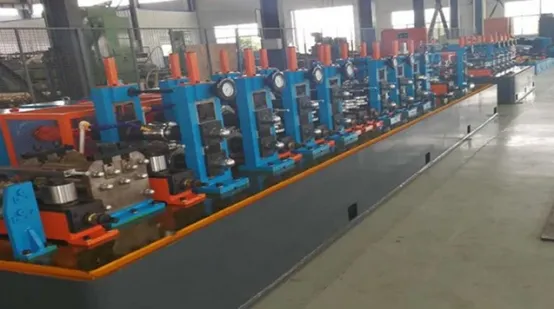
How Does a Forming Machine Determine SSAW Pipe Shape and Diameter?
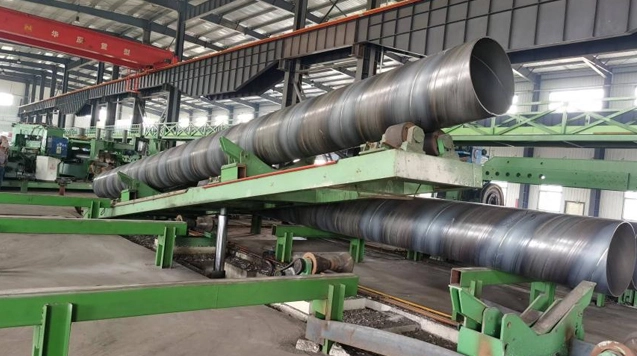
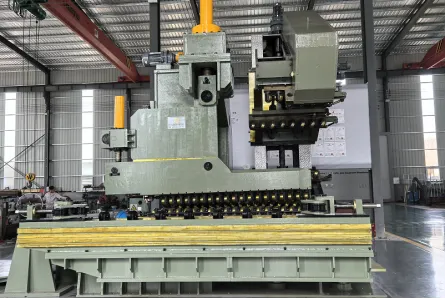
A forming machine determines the shape and diameter of an SSAW (Spiral Submerged Arc Welded) pipe primarily by controlling the forming angle, the width and thickness of the steel strip, and the position of the forming rollers. During production, the steel strip is continuously fed into the forming section and gradually bent into a spiral shape around a cylindrical forming path. The forming angle determines how the strip travels relative to the pipe axis, directly influencing the relationship between strip width, pipe diameter, and spiral weld angle. For a given strip width, changing the forming angle changes the resulting pipe diameter, while adjusting the roller positions and forming geometry helps maintain the required circular cross-section. The machine must also account for the steel strip’s mechanical properties, because these factors affect how the material behaves during bending.
How Do Downstream Machines Work with These Four Core Machines, from Forming to Final Inspection?
Downstream operations may include repeat NDT, hydrostatic testing, pipe-end expansion, dimensional and visual inspection, length and weight measurement, corrosion protection, marking, and packaging.
Not every line needs the same post-processing; pipe-end expansion, corrosion protection, and reinspection vary by specification, application, customer, and standard.
Downstream connects to upstream: stable feeding, edge preparation, and controlled forming enable reliable welding and dimensional control, but final conformity must still be verified through prescribed inspection.
How Should Buyers Evaluate These 4 Types of Equipment When Purchasing an SSAW Pipe Production Line?
Evaluation area | Questions to ask the equipment supplier |
Target pipe specifications | What pipe diameters, wall thicknesses, steel grades, and product combinations will the line manufacture? |
Raw material compatibility | What strip specifications can the uncoiler, leveling machine, and edge processing equipment each handle? |
Continuous feeding capability | How do the coil-change, strip-end joining, accumulation, and feeding systems work together? |
Edge processing quality | Does the line use edge trimming or milling? How are edge dimensions and conditions controlled? |
Forming range | What pipe diameters, wall thicknesses, and strip widths can the forming machine accommodate? How are adjustments made when changing specifications? |
Welding system integration | How do forming, weld gap control, and double-sided submerged arc welding work together? |
Inspection and post-processing | What configurations are provided for in-line inspection, cutting, hydrostatic testing, and pipe-end processing? |
Automation and maintenance | Which operations are automatically controlled? What are the requirements for wear parts, maintenance, and spare parts supply? |
Proven Project Showcase: Large-Diameter Spiral Pipe Mill in Bangladesh
TXH completed the installation of a spiral pipe mill in Bangladesh for large-scale water transmission applications. The line is designed to produce pipes with diameters of 630–3620 mm and wall thicknesses of 6.0–25.4 mm.
Projects of this scale demonstrate the importance of matching uncoiling, leveling, edge milling, and forming equipment to the required production range. Coordinated equipment design helps establish a stable manufacturing process, from initial strip preparation to spiral pipe forming.
Explore TXH’s Bangladesh Project
FAQs
1. How Does Uncoiler Tension Affect SSAW Pipe Production?
Proper uncoiler tension ensures stable feeding and prevents slack, misalignment, and interruptions; too much or too little tension destabilizes leveling and forming.
2. What Happens If the Leveling Machine Does Not Flatten the Steel Strip Properly?
Residual curvature causes unstable feeding, inconsistent forming, and dimensional deviations. Proper leveling ensures the strip enters edge milling and forming in consistent condition.
3. Why Is Edge Milling Important Before Spiral Pipe Forming and Welding?
Edge milling ensures consistent edge alignment and welding. Poor preparation causes weld defects, inconsistent seam geometry, and rework.
References / External Resources
American Iron and Steel Institute (AISI)
https://www.steel.org/steel-technology/steel-production/glossary/
ISO 3183 standard