English
×
Search
Submerged Arc Welding (SAW) is a kind of joining technology used in a Spiral Pipe Mill to create strong and continuous spiral weld seams. Unlike simple joining methods, SAW in a spiral pipe mill is integrated with the forming process. The welding system must work continuously with the forming speed to maintain stable penetration, accurate weld positioning, and consistent seam quality. Understanding the complete spiral welded pipe process is important for manufacturers who need stable production quality.
Submerged Arc Welding is selected for spiral pipe mills because it has many advantages. A stable SAW process helps control weld penetration, reduce welding defects, and improve the mechanical performance of the finished pipe.
In a Spiral Pipe Mill, welding follows the continuous forming process of the steel strip.
The production sequence usually includes:
Steel coil preparation and leveling
Spiral forming through forming rolls
Weld gap adjustment and edge alignment
Internal submerged arc welding
External submerged arc welding
Weld inspection and pipe finishing
When the steel strip moves forward, the forming unit generates a spiral pipe shape, and the welding system follows the rotating pipe position. Such synchronization enables the spiral seam to be continuously welded.
A welding head positioned inside the pipe applies the first SAW pass along the spiral joint. The main purpose of internal welding is to establish proper root penetration and ensure that both edges of the steel strip are fully fused together. The welding parameters, including current, voltage, wire feeding speed, and welding speed, must be accurately controlled to achieve stable penetration.
A properly formed internal weld provides the foundation for the following external welding process and helps prevent defects such as incomplete fusion or insufficient penetration.
After internal welding, the external welding system completes the second side of the spiral seam. The outside weld adds reinforcement to the joint and improves the overall strength of the welded area.
The combination of internal and external SAW creates a double-sided welded structure. This process improves weld integrity by ensuring that the joint receives sufficient heat input and filler material from both sides.
Double-sided submerged arc welding provides several advantages compared with single-side welding:
Better weld penetration through the pipe wall
More stable weld bead formation
Improved mechanical strength
Reduced risk of internal welding defects
For applications such as water transmission pipelines, oil and gas pipelines, and structural projects, consistent spiral weld quality is essential for long-term service performance.
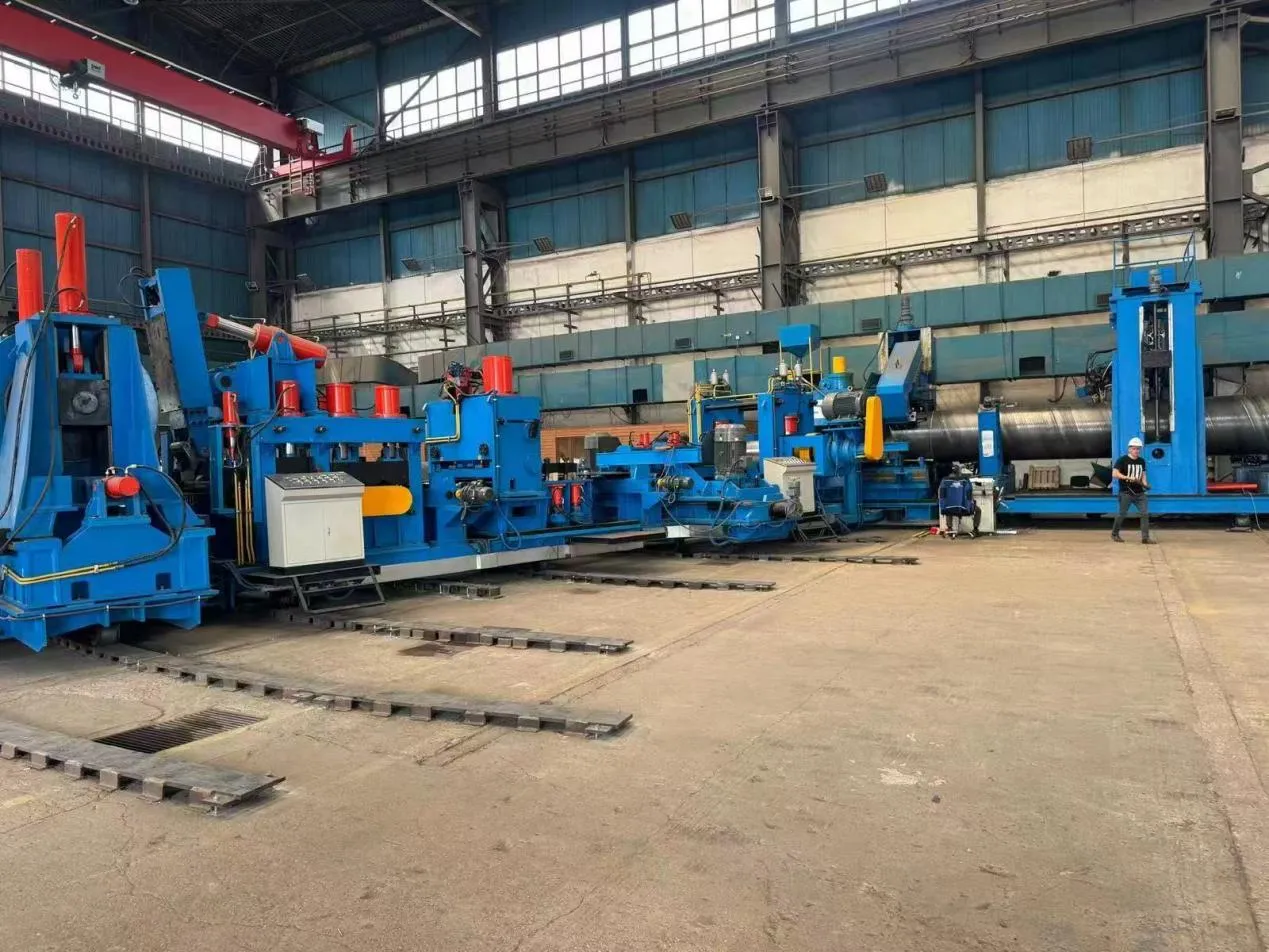
For large diameter spiral welded pipe production, stable internal and external submerged arc welding is essential to maintain weld penetration and seam strength. TianxiangHao supplied a spiral pipe mill for a European project with a pipe diameter range of 406–2232 mm and thickness up to 22 mm.
The project demonstrates the importance of coordinated forming and double-sided SAW technology. By synchronizing spiral forming speed with welding parameters, the production line achieves consistent spiral seam quality for different pipe specifications.
Welding wire is the filler material that forms the weld metal during the submerged arc welding process. It is continuously supplied into the welding arc, where it melts and combines with the base steel edges to create the weld joint.
In a Spiral Pipe Mill, welding wire selection directly affects:
Weld strength
Chemical composition of the weld metal
Deposition efficiency
Weld appearance
Flux is one of the key elements that defines the SAW process. During welding, the flux layer covers the arc and molten metal, preventing exposure to oxygen and nitrogen in the atmosphere.
The flux performs several important functions:
Stabilizing the welding arc
Protecting the molten weld pool
Reducing oxidation
Improving weld surface quality
Helping control slag formation
The correct combination of welding wire and flux is essential for maintaining stable weld chemistry and mechanical properties.
The quality of a spiral weld seam relies on precise control of multiple welding parameters very much, including:
Welding current
Arc voltage
Welding speed
Wire feeding speed
Flux selection
For example, unsuitable current or voltage settings may affect weld shape and consistency. Therefore, modern spiral pipe mills use automatic control systems to maintain stable welding conditions during continuous production.
Before the welding process begins, the flat steel strip will be formed into a spiral shape through a series of forming rolls. For a suitable welding gap, the edges of the steel strip must be accurately aligned.
A key feature of SSAW production is the synchronization between pipe forming and welding.
The welding system must follow the movement of the spiral seam while maintaining:
Stable arc position
Uniform welding speed
Consistent penetration depth
Any mismatch between forming speed and welding speed may lead to weld deviation or quality problems.
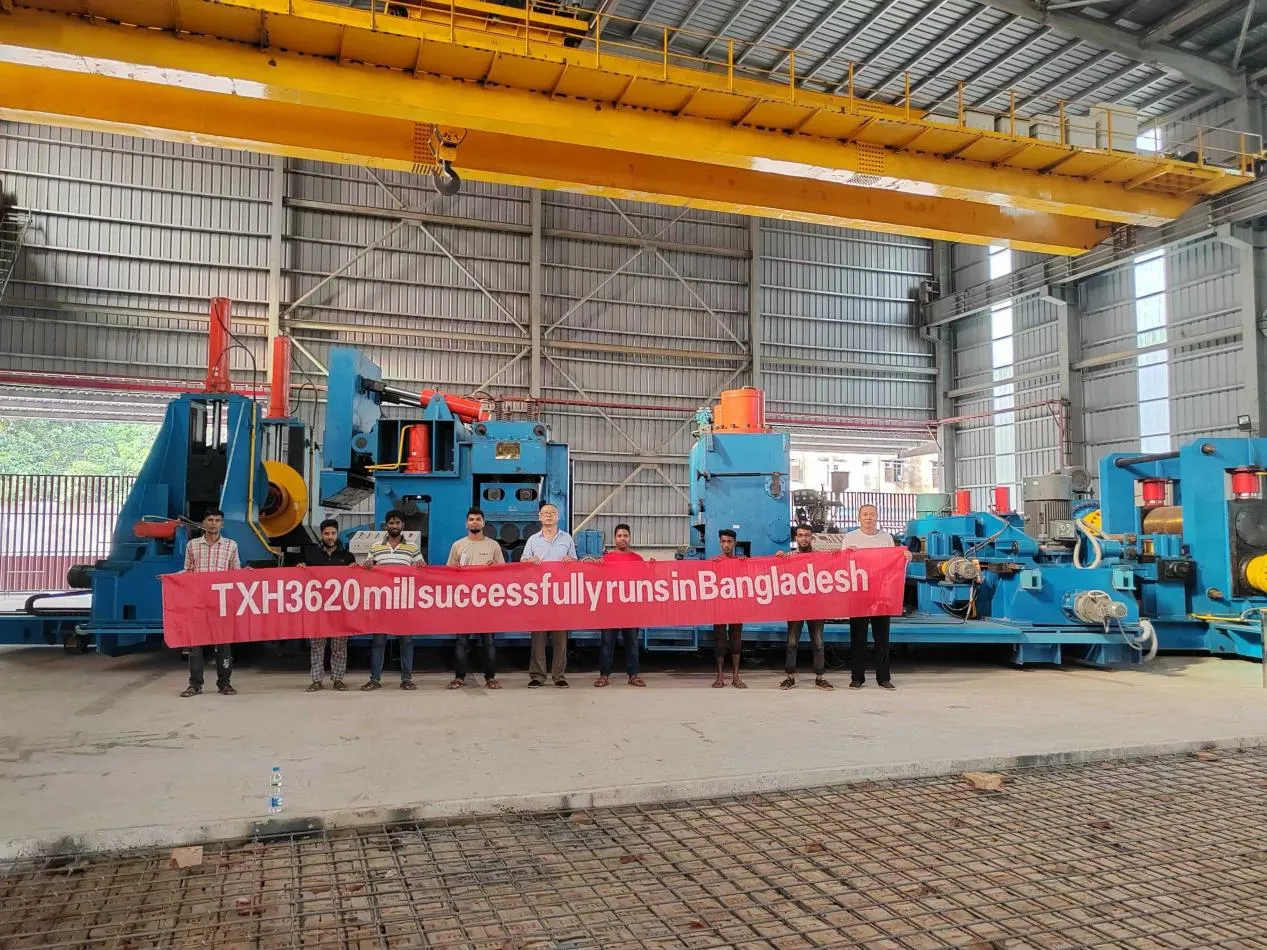
This is a Bangladesh spiral pipe mill project supplied by TianxiangHao. It was designed for a wide production range, with pipe diameters from 630 mm to 3620 mm and thicknesses from 6 mm to 25.4 mm.
Producing pipes with different diameters and wall thicknesses requires accurate control of forming conditions and welding parameters. The project highlights how a modern Spiral Pipe Mill integrates all the production process to maintain stable production efficiency.
The complete transformation process can be summarized as:
Steel coil → Spiral forming → Edge alignment → Internal SAW → External SAW → Continuous spiral weld seam → Inspection
Through this continuous process, a flat steel strip becomes a finished spiral welded pipe with a strong and uniform welded joint.
Modern Spiral Pipe Mills use automated monitoring systems to maintain welding stability during production, reduce human error and improve production repeatability.
After welding, the spiral welded pipes usually need to get inspection procedures to verify the quality of weld.
Common inspection methods include Ultrasonic Testing (UT), X-Ray inspection, and hydrostatic testing. These inspection processes help identify various possible issues.
Besides weld inspection, pressure testing is another important step for pipeline reliability. A pipe hydrotest machine can help verify whether welded pipes meet pressure requirements before transportation and installation.
The quality of spiral weld seams depends on multiple factors. Proper control of these factors helps ensure consistent penetration, weld strength, and production reliability.
| Key Factor | Influence on SAW Quality |
|---|---|
| Steel Strip Edge Preparation | Accurate edge alignment and proper welding gap ensure stable fusion and reduce defects such as incomplete penetration. |
| Welding Wire and Flux Selection | The correct combination improves weld metal properties, arc stability, and overall seam performance. |
| Welding Parameters | Optimized current, voltage, welding speed, and wire feeding speed help maintain consistent weld penetration and bead formation. |
| Equipment Stability and Automation | Precise forming control, automatic welding adjustment, and monitoring systems improve production consistency. |
For large diameter spiral welded pipe production, combining automated welding control with inspection systems can further improve quality assurance. Pipeline x ray equipment (Internal Link) provides detailed weld examination during production.
Submerged Arc Welding is the central technology that connects spiral forming with final pipe quality. Through the cooperation of internal welding, external welding, welding wire, and flux, a Spiral Pipe Mill can continuously produce strong and reliable spiral welded pipes. A well-designed spiral pipe mill does not only produce pipes efficiently but also ensures consistent weld quality throughout long-term production.