English
×
Search
Efficiency is one of the most important performance indicators in modern pipe manufacturing. Whether serving oil and gas transmission projects, municipal water infrastructure, or industrial construction, manufacturers are under constant pressure to increase output while maintaining product quality and controlling operating costs.
A spiral welded pipe machine is an industrial production system that forms steel strip coils into spiral-shaped pipes and continuously welds the edges to produce pipes of various diameters and wall thicknesses.
While many buyers focus on machine speed when evaluating equipment, actual production efficiency depends on a combination of factors, including raw material quality, pipe specifications, forming accuracy, welding performance, automation levels, and operational management. Understanding these variables can help manufacturers optimize production and improve long-term profitability.

The efficiency of a spiral pipe production line begins with the quality of the incoming steel coil. Consistent coil dimensions and surface conditions allow the forming and welding systems to operate smoothly, reducing the need for adjustments and minimizing downtime.
Variations in coil thickness, edge quality, or surface defects can lead to unstable forming, welding inconsistencies, and increased inspection requirements. According to the American Iron and Steel Institute (AISI), dimensional consistency is a critical factor in downstream steel processing and manufacturing performance.
| Coil Condition | Potential Production Impact |
| Consistent width and thickness | Stable forming and welding |
| Surface defects | Increased inspection and rework |
| Poor edge quality | Higher risk of weld defects |
| Material inconsistency | More machine adjustments |
Manufacturers that prioritize material quality often achieve more stable production and lower scrap rates throughout the spiral welded pipe manufacturing process.
Pipe specifications have a direct impact on production speed and equipment utilization. For example, producing a large diameter spiral welded steel pipe typically requires greater forming force, more precise alignment, and increased handling capacity compared with smaller-diameter products. Similarly, heavy-wall pipes require higher welding energy and longer processing times than thin-wall pipes.
Different product requirements often call for specialized equipment configurations. This is why many manufacturers invest in dedicated large-diameter, heavy-duty, or thin-wall spiral pipe production lines rather than relying on a single setup for all applications.
The relationship between pipe specifications and production efficiency is illustrated below.
| Pipe Type | Production Challenge | Efficiency Impact |
| Thin-wall pipe | Easier forming and welding | Higher production speed |
| Heavy-wall pipe | Increased welding energy requirements | Lower production speed |
| Small diameter pipe | Faster forming process | Higher throughput |
| Large diameter pipe | More complex forming and handling | Reduced line speed |
Selecting equipment that matches the intended product range is one of the most effective ways to improve productivity.
Forming accuracy is a key factor affecting both production speed and product quality.
During production, steel strip coils are continuously shaped into a spiral configuration before welding. If roller alignment is not properly maintained, dimensional deviations can occur, leading to production interruptions, increased scrap, and reduced output.
A stable forming system helps manufacturers maintain:
Consistent pipe roundness
Accurate diameter control
Reliable weld seam alignment
Even small improvements in forming precision can significantly reduce adjustment time and improve overall line efficiency. In practice, a well-maintained spiral welded pipe mill can often achieve higher utilization rates because operators spend less time correcting production issues.
The welding section is often considered the heart of a spiral pipe production line. High production speeds are only beneficial when weld quality remains consistent. Poor welding performance can result in defects such as incomplete fusion, porosity, or lack of penetration, all of which increase rework and reduce effective output.
According to the American Welding Society (AWS), welding procedure consistency is essential for minimizing defects and maintaining production efficiency in industrial fabrication environments.
Several factors influence welding productivity, including:
Welding current and voltage stability
Heat input control
Edge preparation quality
Seam tracking accuracy
Many manufacturers use ultrasonic pipe inspection equipment to verify weld integrity during or after production. Early defect detection helps reduce downstream processing losses and improves overall manufacturing efficiency.
Automation continues to play a growing role in modern pipe manufacturing. The International Federation of Robotics (IFR) reported that global industrial robot installations exceeded 540,000 units in a recent year, demonstrating the increasing adoption of automation across manufacturing sectors.
In spiral pipe production, automation can improve consistency, reduce labor-intensive tasks, and minimize production interruptions.
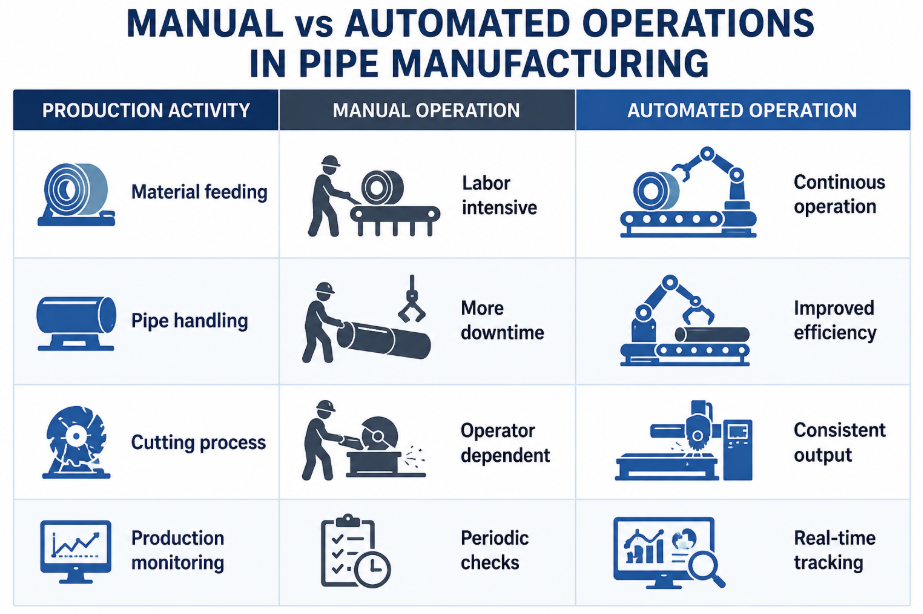
Automated feeding systems, pipe handling equipment, and process monitoring technologies help maintain stable production flow while reducing operational variability.
Equipment performance alone does not determine production efficiency. Human factors remain equally important.
Experienced operators can identify abnormal conditions early, optimize machine settings, and minimize production disruptions. Effective production management also helps improve equipment utilization by reducing changeover times and maintaining consistent workflow.
Successful manufacturers often focus on:
Standardized operating procedures
Regular workforce training
Preventive inspections
Production data monitoring
When operators understand both equipment capabilities and process requirements, production lines are more likely to achieve their target output levels consistently.
Improving production efficiency typically requires a combination of technical and operational improvements.
Use high-quality steel coils with consistent specifications.
Optimize forming and welding parameters for each product type.
Implement preventive maintenance programs to reduce downtime.
Integrate automated handling and monitoring systems where appropriate.
Track key performance indicators such as output, scrap rates, and machine utilization.
For manufacturers focused on small-diameter, high-speed tube production, evaluating a high frequency welded pipe mill alongside spiral welding technology may also help determine the most suitable solution for specific production requirements.
The production efficiency of a spiral welded pipe machine depends on much more than line speed. Steel coil quality, pipe dimensions, forming accuracy, welding stability, automation, and operational management all influence overall performance. By optimizing these factors and aligning equipment capabilities with production goals, manufacturers can improve output, reduce downtime, and maintain consistent product quality in a competitive market.
There is no single determining factor, but steel coil quality, welding stability, and equipment reliability are among the most significant contributors to production efficiency.
In most cases, yes. Larger diameter pipes typically require more complex forming, handling, and welding operations, which can reduce overall production speed.
Preventive maintenance, operator training, equipment monitoring, and consistent raw material quality can help minimize unplanned downtime.
Poor weld quality often leads to rework, additional inspections, and product rejection, all of which negatively affect production output and operating costs.
1.American Iron and Steel Institute (AISI). Steel Manufacturing Resources and Industry Standards.
2.American Welding Society (AWS). Welding Fundamentals and Quality Standards.
3.Wikipedia. Spiral Welding.