Which Technical Parameters Matter Most When Selecting a Spiral Pipe Mill?
Selecting a spiral pipe mill requires more than comparing equipment specifications on a quotation sheet. Buyers need to understand which parameters directly affect production capability, finished-pipe quality, and operating efficiency. Focusing on headline figures alone may lead to equipment that cannot consistently meet actual production requirements.
The most important parameters include the stable pipe diameter and wall thickness range, raw material compatibility, forming and welding capabilities, actual production capacity, and equipment acceptance criteria.
Maximum pipe diameter, main drive power, and theoretical production speed are also relevant, but none can independently determine whether a machine is suitable.
Which Technical Parameters Are Most Important When Selecting a Spiral Pipe Mill, and Which Are Secondary?
The most important parameters are those that determine whether the spiral pipe mill can consistently produce the required pipe specifications under planned operating conditions. These include the stable production range, material compatibility, forming and welding configuration, actual output, and finished-pipe inspection requirements.
By comparison, maximum pipe diameter, maximum wall thickness, main drive power, and maximum line speed should not be evaluated in isolation. These figures describe individual aspects of machine capability, but they do not necessarily represent stable mass-production performance.
Parameter | Importance | What buyers should verify |
Pipe diameter and wall thickness range | Critical | Stable production capability for target specifications |
Raw material compatibility | Critical | Steel grades, strip dimensions, and material conditions |
Forming and welding configuration | Critical | Compatibility with target pipe dimensions and quality requirements |
Actual production capacity | Critical | Achievable output under defined operating conditions |
Equipment acceptance criteria | Critical | Measurable performance and inspection requirements |
Maximum drive power | Supporting indicator | Whether the drive system suits the intended production range |
Maximum line speed | Supporting indicator | Whether the stated speed applies to the target pipe specifications |
Automation features | Application-dependent | Practical functions and verifiable performance benefits |
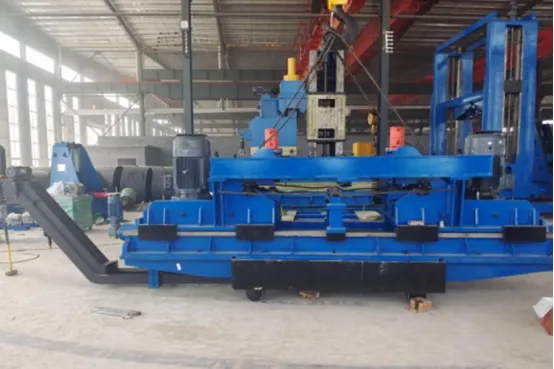
How Do Different Technical Parameters Affect Spiral Pipe Mill Performance?
Different parameters affect different aspects of production. Pipe dimensions and material properties determine whether the equipment can handle the required products, while forming and welding systems influence process stability and finished-pipe quality. Electrical controls and automation affect parameter management, product changeovers, and operating consistency.
Production capacity must also be evaluated as a complete-line result. Theoretical line speed is not the same as the quantity of acceptable finished pipes produced over a working shift. Cutting, inspection, material handling, and specification changes may all affect actual output.
For pipeline applications, buyers can consult ISO 3183 — Steel Pipe for Pipeline Transportation Systems to identify relevant product requirements.
Which Spiral Pipe Mill Specifications and Parameter Details Are Easy to Overlook During Equipment Selection?
Some important details receive less attention during initial supplier comparisons but can significantly affect equipment suitability.
First, buyers should distinguish between specifications suitable for regular mass production and those that require special configurations or trial production. A spiral pipe mill machine producing a particular pipe during a demonstration does not automatically prove that it can manufacture the same specification consistently over extended production periods.
Second, raw material conditions must be clearly defined. Steel grade, strip width, thickness, coil weight, and material properties should be checked against the proposed equipment configuration. A general material list is not sufficient confirmation that every material and pipe-size combination is supported.
Third, the supply scope needs careful review. Auxiliary systems, edge preparation equipment, inspection facilities, pipe cutting and chamfering machine, and downstream processing systems may be optional rather than standard components. Buyers should confirm which items are included in the quotation and which require additional investment.
Finally, welding and inspection requirements must be considered together. For relevant line-pipe applications, the API Specification 5L resource provides information about the applicable line-pipe specification. Selecting equipment with a particular welding feature does not, by itself, establish that the finished pipes comply with the required standard.
How Do Forming and Welding Systems in a Spiral Pipe Mill Affect Pipe Quality?
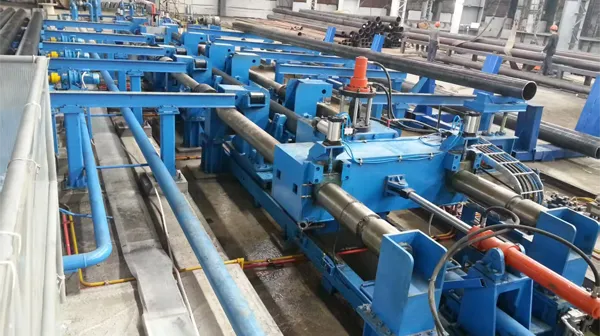
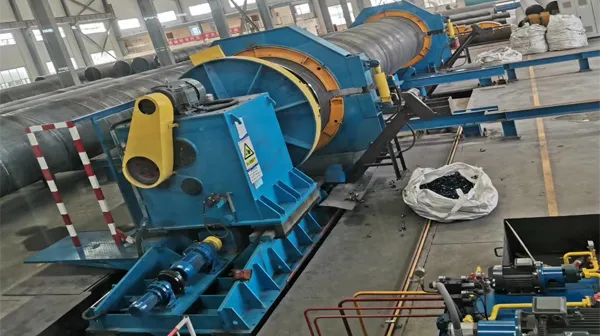
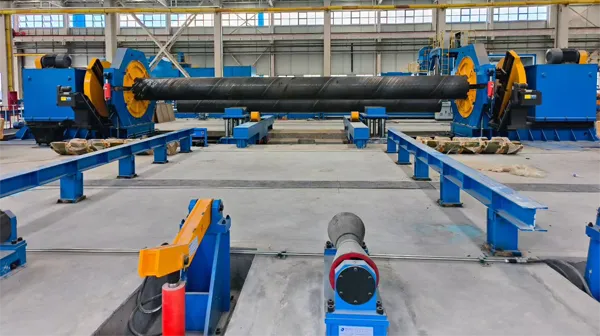
The forming and welding systems are central to the production process because they must work together to produce pipes that meet the required dimensions and quality criteria.
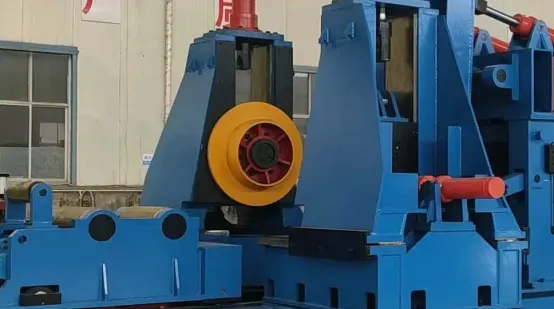
For the forming system, buyers should examine the forming structure, adjustment range, strip feeding mechanism, and compatibility with the intended pipe diameters and wall thicknesses. Main drive power should be assessed alongside these factors rather than treated as an independent measure of overall machine performance.
For the welding system, key considerations include internal and external welding configurations, welding processes, power sources, process parameter adjustment, and weld seam tracking. Where submerged arc welding is used, buyers should also confirm the required flux handling, recovery, and drying equipment.
Edge preparation capabilities, including milling or beveling, should match the intended welding process and product requirements. The relevant welding procedures and inspection methods should be defined before equipment acceptance. The American Welding Society standards and publications provide an additional authoritative resource for reviewing welding-related standards and technical guidance.
How Can Buyers Communicate Their Technical Requirements More Professionally When Purchasing a Spiral Pipe Mill?
When comparing quotations, don’t just look at the prices and headline specifications. Ask suppliers which pipe sizes the machine can handle reliably, what equipment is included, and whether any special configurations are needed. If a supplier promises a certain production speed or efficiency improvement, ask what those figures are based on.
It's also worth discussing testing and acceptance before placing an order. Agree on how production capacity will be measured, what sample pipes will be checked, and which quality requirements the finished products must meet. Make sure installation, commissioning, training, and after-sales support are covered in the agreement, too.
TXH' Case Showcase:
TXH's 3620 Spiral Pipe Mill project in Bangladesh illustrates TXH provides technical support for installation planning, including site surveys and water and electrical layout drawings, helping customers prepare for equipment installation and commissioning. Clear technical communication helps establish a more suitable equipment configuration and makes the transition from equipment delivery to commissioning more straightforward.
Frequently Asked Questions
Is maximum pipe diameter the best way to compare spiral pipe mills?
No. Maximum diameter is only one indicator. Buyers should confirm the supported combinations of pipe diameter, wall thickness, material grade, and production conditions.
How can buyers verify a spiral pipe mill's actual production capacity?
Request the conditions behind the supplier’s capacity figures and agree on a trial-production method. The evaluation should consider target pipe specifications, operating time, product changeovers, inspection requirements, and acceptable finished output.
Does a high-power drive guarantee better production performance?
No. Drive power must be evaluated alongside the forming structure, transmission system, material conditions, and target production range.
References / External Resources
API Specification 5L resource
https://www.api.org/products-and-services/standards/important-standards-announcements/
American Welding Society standards and publications