English
×
Search
In steel pipe manufacturing, selecting the right production technology is a strategic decision that directly impacts product range, production efficiency, and long-term profitability. Spiral welding and longitudinal welding are the two most widely used methods in modern pipe production, but they serve different industrial needs.
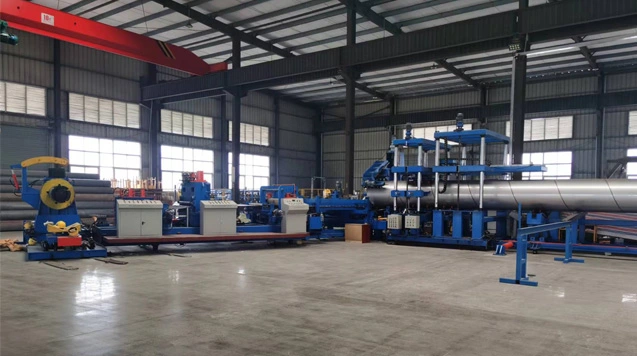
A spiral welded pipe machine forms steel strip coils into a helical shape and continuously welds the seam to produce pipes with flexible diameter ranges and strong suitability for large-diameter applications.
A longitudinal welded pipe machine, often based on high-frequency welding technology, forms steel strips into a straight seam pipe and is widely used for high-speed production of small- and medium-diameter pipes.
Choosing between these two systems requires understanding not only the forming principle, but also production efficiency, application scenarios, and long-term investment value.
Spiral pipe welded machines use steel coil as raw material and feed it into a forming system where the strip is continuously bent at a controlled angle. The edges of the strip are then welded together using submerged arc or equivalent welding methods to form a spiral seam pipe.
This production method offers a unique advantage: diameter flexibility. By adjusting the forming angle, manufacturers can produce different pipe diameters without changing the steel strip width significantly.
Spiral welded pipes are widely used in:
Oil and gas transmission pipelines
Water supply systems
Long-distance infrastructure projects
Structural steel pipeline networks
Many manufacturers choose specialized configurations such as large diameter spiral steel pipe production lines or heavy-duty spiral systems depending on project requirements.

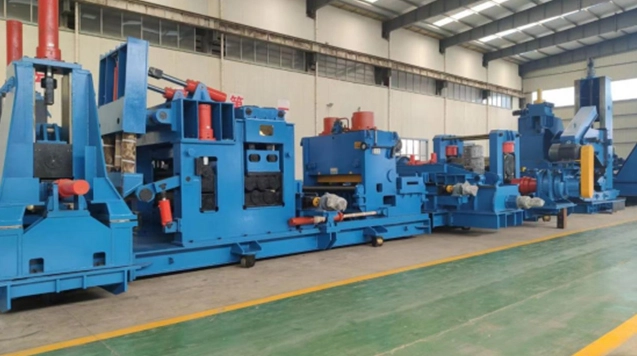
Longitudinal welded pipe machines form steel strip coils into a cylindrical shape using a series of rollers. The edges are aligned and welded along a straight seam using high-frequency induction welding technology.
This method is widely recognized for its efficiency in producing standardized pipe sizes with high output rates.
Typical applications include:
Structural tubing
Mechanical engineering components
Construction materials
Automotive and furniture tubes
Compared with spiral welding, longitudinal welding is generally optimized for high-speed production of smaller diameter pipes with consistent specifications.
Pipe diameter range is one of the most important decision factors when selecting a production system.
Spiral welding technology provides higher flexibility in diameter adjustment, especially for large-scale pipeline projects. In contrast, longitudinal welding is more efficient for standardized small and medium diameters.
| Factor | Spiral Welded Pipe Machine | Longitudinal Welded Pipe Machine |
| Large-diameter production | Excellent | Limited |
| Small-diameter production | Possible (special configuration) | Excellent |
| Diameter flexibility | High | Moderate |
| Product switching | Flexible | More fixed |
For manufacturers producing large diameter spiral welded steel pipe, spiral systems are generally more suitable due to their adaptability to project-based requirements.
Production efficiency is not only determined by machine speed. It is also influenced by changeover frequency, product variety, and downtime management.
Longitudinal welded pipe machines typically achieve higher line speeds for standardized products, making them suitable for mass production environments.
Spiral welded systems, however, provide better flexibility when multiple diameters or project-based specifications are required.
| Factor | Spiral Welding | Longitudinal Welding |
| Production speed | Medium | High |
| Product flexibility | High | Moderate |
| Changeover frequency impact | Low | Higher |
| Best use scenario | Project-based production | Mass production |
This means efficiency should be evaluated based on total output and operating conditions, not just speed alone.
Investment decisions in pipe production lines must consider both initial cost and future scalability.
Spiral welding systems often provide stronger long-term flexibility for manufacturers targeting multiple large-scale infrastructure projects. Longitudinal systems are often chosen for stable, standardized production environments.
| Factor | Spiral Welding Line | Longitudinal Welding Line |
| Initial investment | Medium–High | Medium |
| Product range flexibility | High | Moderate |
| Expansion capability | Strong | Moderate |
| Market adaptability | High | Medium |
Manufacturers planning to expand into multiple pipeline applications often prefer spiral systems due to broader adaptability.
Different industries naturally favor different pipe production technologies based on performance requirements.
Oil & gas transmission systems
Water transportation infrastructure
Long-distance pipeline projects
Energy distribution systems
Structural steel construction
Mechanical tubing applications
Automotive and furniture manufacturing
General industrial components
In many large infrastructure projects, spiral welded pipes are preferred due to their suitability for long-distance, large-diameter transportation systems.
Before investing in a production system, manufacturers should evaluate several key business and technical factors:
What pipe diameter range will you primarily produce?
Is your market focused on infrastructure projects or standardized products?
How frequently will production specifications change?
What is your expected monthly or annual output?
Do you plan to expand into new pipe applications in the future?
These questions help determine whether flexibility or production speed should be prioritized.
The following table provides a simplified decision guide:
| Production Requirement | Recommended Solution |
| Large-diameter pipeline projects | Spiral Welded Pipe Machine |
| Water transmission infrastructure | Spiral Welded Pipe Machine |
| Small-diameter structural tubes | Longitudinal Welded Pipe Machine |
| High-speed standardized production | Longitudinal Welded Pipe Machine |
| Multi-diameter flexible production | Spiral Welded Pipe Machine |
Both technologies are effective, but the optimal choice depends on your product strategy and market direction.
Spiral pipe welding machine and longitudinal welded pipe machine serve different roles in modern steel pipe manufacturing. Spiral systems offer greater flexibility and are ideal for large-diameter and project-based production, while longitudinal systems excel in high-speed, standardized manufacturing. The best choice depends on production goals, market demand, and long-term investment planning.
Spiral welded pipe machines are generally more suitable for large-diameter applications due to their flexible forming structure.
Longitudinal welded pipe machines typically achieve higher production speeds in standardized manufacturing conditions.