Spiral Welded Pipe vs ERW Pipe: How Do Production Process and Applications Differ?
Welded steel pipes are commonly manufactured using ERW (electric resistance welding), LSAW (longitudinal submerged arc welding), or SSAW (spiral submerged arc welding). Their raw materials, forming methods, seam structures, dimensions, and applications differ. This article compares SSAW and ERW, with LSAW as a reference.
Item | ERW | LSAW | SSAW |
Raw material | Hot-rolled coil | Medium/heavy plate | Hot-rolled coil |
Forming | Continuous roll forming | JCOE / UOE / HME | Adjustable helical forming |
Weld seam | Longitudinal resistance weld | Longitudinal, double-sided SAW | Helical, double-sided SAW |
Typical OD* | 21.3–610 mm; some lines to ~813 mm | ~406–1,524 mm | ~219–3,020 mm or more |
Typical wall* | Up to ~20–22 mm | ~6–60 mm | ~4–25.4 mm |
Applications | Gas, water, fire, structural pipe | High-pressure trunk lines, offshore structures | Large water, drainage, piling, ventilation |
1. Overview of the Three Welded Pipe Processes
Indicative ranges only. Actual limits depend on equipment configuration, material, standards, and qualified procedures.
2. Production Process and Welding Differences
ERW: Continuous Roll Forming and High-Frequency Welding
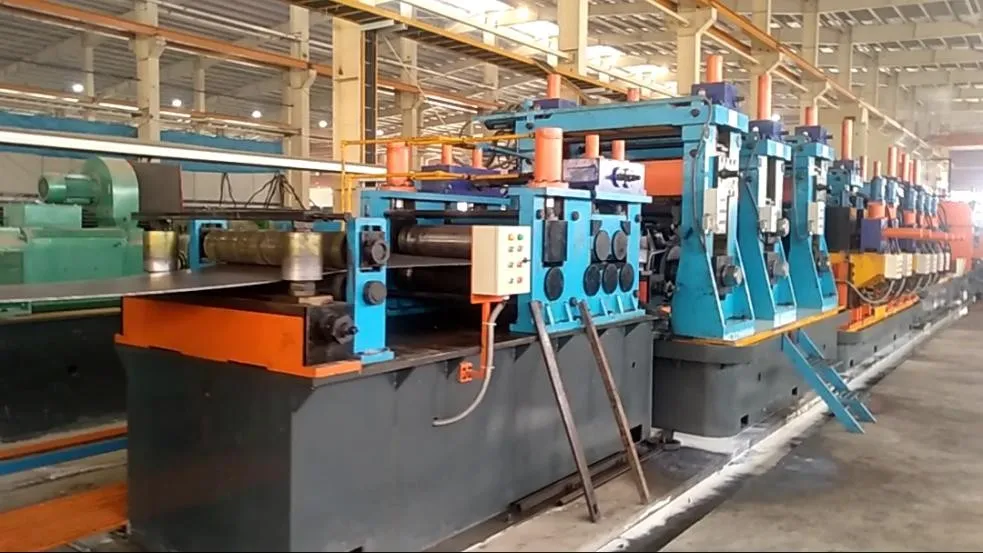
ERW starts with hot-rolled coil, which is uncoiled, leveled, and roll-formed into a tube. High-frequency current heats the edges, and squeeze rolls forge them together without filler wire or flux. Heat treatment, sizing, straightening, and cutting follow. ERW offers a short longitudinal seam and consistent dimensions, making it suitable for small- and medium-diameter pipes with thin to moderate walls. A high frequency welding production line must match the required diameter and strip thickness.
LSAW: Plate Forming and Double-Sided Submerged Arc Welding
LSAW uses medium or heavy steel plate. After edge milling and beveling, the plate is formed by JCOE or UOE, tack-welded, and welded internally and externally by SAW. Expansion, sizing, and finishing follow. JCOE uses successive press strokes and suits thick walls; UOE uses U-forming, O-forming, and mechanical expansion. LSAW is often considered for high-pressure trunk lines requiring controlled dimensions and toughness.
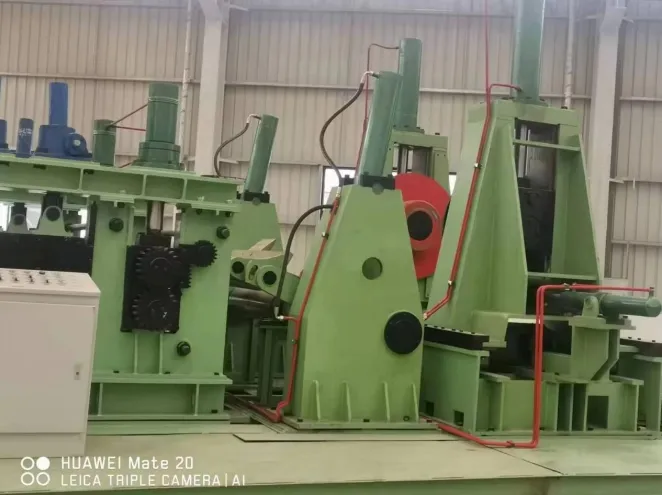
SSAW: Adjustable Helical Forming and Double-Sided SAW
SSAW continuously forms steel coil at a spiral angle while inner and outer seams are welded. Adjusting the angle allows compatible strip widths to produce different diameters. Its flexibility supports mixed-size production. However, the helical seam is longer, often 1.1–1.4 times pipe length, making roundness and weld tracking important. Sizing, centering, and UT/RT inspection help control quality. A spiral welding machine is the core equipment for this process.
3. SSAW vs ERW: Five Practical Differences
Diameter: ERW mainly serves pipes below approximately 610 mm OD, while SSAW can exceed 3,000 mm, depending on configuration.
Raw material: Both use hot-rolled coil, but SSAW adjusts its forming angle to produce different diameters from compatible strip widths.
Welding and inspection: ERW uses high-frequency resistance welding; SSAW uses internal and external SAW and requires inspection along a longer seam.
Capacity and cost: ERW suits repeat, high-volume orders. SSAW offers broader size flexibility. The supplied material estimates a 10–15% ERW cost advantage in comparable projects, but actual costs vary.
Applications: ERW suits municipal gas, water, fire networks, and structural tubing. SSAW suits large water transmission, drainage, piling, ventilation, and permitted lower-pressure pipelines.
4. Standards, Inspection and Procurement Checks
Before selecting equipment, confirm diameter, wall thickness, steel grade, design pressure, service temperature, and output. Specify the applicable standard and edition, such as GB/T 9711, API 5L, or ISO 3183, including PSL and project requirements.
Inspection may include hydrostatic testing, UT, RT, MT, PT, and visual examination. Define coverage, acceptance criteria, repair procedures, and traceable records. Dimensional tolerances, ovality, weld reinforcement, bevels, material certificates, and NDT qualifications should also be specified.
A steel pipe hydrostatic pressure testing machine and industrial X-ray equipment can be included when required.
For quotations, clarify equipment configuration, utilities, plant layout, commissioning, training, spare parts, warranty, and delivery. Agree on trial-pipe testing, output measurement, and acceptance criteria.
5. TXH Equipment Scope and Selection Guidance
Tianxianghao (TXH), based in Yanshan, Hebei, focuses on SSAW production lines and supporting machinery. Its range includes different diameter and wall-thickness configurations, inner and outer welders, hydrotesters, beveling, and NDT equipment. Selection should match pipe dimensions, materials, production targets, standards, and inspection requirements rather than nominal speed alone.
6. Frequently Asked Questions
1. Is spiral welded pipe stronger than ERW pipe?
Neither process is automatically stronger. Performance depends on steel grade, wall thickness, welding procedure, manufacturing quality, and acceptance requirements.
2. Is ERW always cheaper than SSAW?
ERW may be more economical for compatible small- and medium-diameter, high-volume orders. SSAW can be more practical for large diameters and mixed-size production.
3. When should LSAW be considered?
LSAW is worth evaluating for heavy-wall plate pipe, high toughness, and demanding high-pressure applications. Confirm suitability against project specifications and design codes.
Conclusion
Choose ERW for suitable smaller diameters and repeat production, SSAW for larger diameters and varied sizes, and LSAW for demanding heavy-wall applications. The final choice must satisfy project standards, operating conditions, dimensions, and verified production capability.
Standards References: API Specification 5L | ISO 3183:2019