English
×
Search
An ERW pipe mill is not a single machine but a coordinated production line that converts steel strip into continuously welded and sized pipe. For buyers planning a new mill, the correct configuration depends on the finished pipe range, steel grade, wall thickness, required output, welding speed, dimensional tolerance, product shape, cutting method, and downstream processing requirements.
The lowest-priced line is rarely the best purchasing benchmark. A mill that cannot maintain stable forming, welding, sizing, or cutting at the required production speed can increase scrap, changeover time, and operating cost. The better approach is to define the products you intend to manufacture first, then configure the line around those specifications.
Many ERW pipe mill quotations emphasize maximum production speed, but speed alone does not determine whether a line is suitable.
Before comparing equipment, buyers should first define the actual product range:
Minimum and maximum pipe outside diameter
Wall thickness range
Round, square, or rectangular pipe requirements
Steel strip width and thickness
Material and steel grade
Finished pipe length
Required dimensional tolerance
Target annual or hourly production output
A line producing small-diameter furniture tubing has different forming loads, welding requirements, tooling, and output expectations from a mill producing larger structural or industrial pipe.
If the product range is too broad, buyers should also ask whether one line can cover all required specifications economically. In some projects, a narrower operating range can provide faster changeovers and more stable production than an oversized universal configuration.
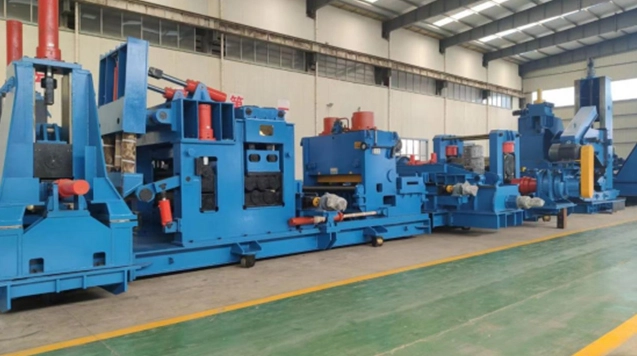
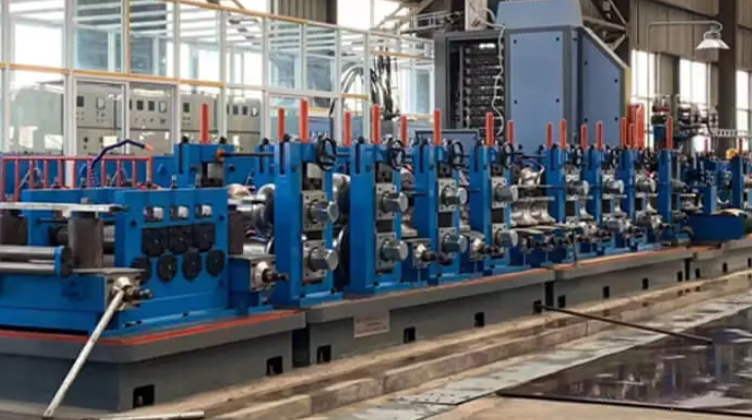
The performance of an ERW line depends on how each section works with the next. A typical line may include coil preparation, strip accumulation, forming, high-frequency welding, sizing, cutting, and finished-pipe handling.
| Line Section | Main Function | What Buyers Should Confirm |
| Uncoiler & Strip Preparation | Feeds steel strip into the production line | Coil weight, strip width, thickness and loading method |
| Accumulator | Stores strip so the mill can continue during coil changes | Storage capacity and compatibility with target line speed |
| Forming Mill | Gradually forms flat strip into an open pipe shape | Roll design, pipe range, tooling accuracy and changeover time |
| High-Frequency Welding | Joins the strip edges into a continuous longitudinal weld | Power range, welding stability and compatibility with material thickness |
| Sizing Mill | Controls final pipe dimensions and shape | Diameter tolerance, shape accuracy and required product range |
| Flying Cut-Off | Cuts continuously moving pipe to specified lengths | Cutting speed, length accuracy and finished-end requirements |
| Pipe Handling | Transfers finished pipe to downstream operations | Pipe length, weight, sorting and connection with other equipment |
When comparing a high frequency welded pipe mill, buyers should therefore evaluate the complete equipment scope rather than comparing only the forming machine or welder.
Production capacity should be based on saleable finished pipe, not only theoretical mill speed.
Actual output is influenced by forming speed, welding stability, coil change frequency, product changeovers, cutting cycle, tooling setup, scheduled maintenance, and downstream handling.
For example, a mill with a high maximum line speed may still produce less saleable pipe if operators spend excessive time changing rolls between product sizes. Similarly, an undersized accumulator may force production interruptions whenever a new coil is prepared.
Buyers should therefore estimate:
Required tons per year
Expected operating hours per day
Typical product mix
Average number of size changes
Expected utilization rate
Required reserve capacity for future growth
The production target should then be translated into a realistic line speed for the most important pipe specifications rather than one maximum-speed figure.
ERW pipe mill price changes significantly according to equipment scope and production requirements.
Pipe diameter and wall thickness are major cost drivers because larger or heavier products require stronger mill stands, larger rolls, more powerful drives, and greater structural rigidity.
High-frequency welding capacity also affects investment. The welding system must provide sufficient power and control for the intended strip material, thickness, and operating speed.
Automation level can change both initial cost and long-term productivity. Automatic coil handling, strip joining, recipe management, production monitoring, and synchronized cutting can reduce manual intervention but require additional controls and integration.
Tooling and product range also matter. A project requiring multiple round, square, and rectangular sizes may need more roll tooling and more flexible sizing arrangements.
Finally, buyers should confirm whether the quotation includes auxiliary equipment, commissioning, training, spare parts, installation guidance, and line integration. Comparing two prices without comparing the included scope can produce a misleading conclusion.
The intended finished shape should be confirmed before the line is designed.
A mill focused on round pipe can be configured specifically around circular forming and sizing. If the factory also plans to manufacture square or rectangular hollow sections, additional sizing and shaping requirements must be considered.
For square and rectangular products, buyers should provide the required side dimensions, wall thickness, corner radius, tolerance, and whether the line will form round pipe first and then size it into the final shape or use another forming strategy.
An ERW line should be treated as one continuous manufacturing system.
During ERW pipe manufacturing, steel strip is gradually formed before the edges are welded and the pipe passes through subsequent sizing operations. Problems in one section can therefore affect the next stage.
Poor forming can create unstable strip-edge presentation before welding. Welding instability can lead to downstream quality problems. Inaccurate sizing can result in dimensional variation even when the weld itself is acceptable.
For this reason, buyers should ask how roll design, mill alignment, welding position, sizing stands, and line control are coordinated. A successful production line depends on stable interaction between these sections, not simply the specifications of individual machines.
The ERW mill may only be one section of the complete production process.
Depending on the final pipe specification and customer requirements, downstream equipment may include:
Weld seam inspection
Ultrasonic testing
Hydrostatic pressure testing
Pipe chamfering or end facing
Straightening
Marking
Bundling and pipe handling
These requirements should ideally be considered during initial line planning. Adding large inspection or finishing stations later may require additional conveyors, factory space, electrical capacity, and changes to material flow.
To receive a technically useful quotation, buyers should provide enough information for the supplier to calculate the complete mill configuration.
Finished product: round, square, rectangular, or multiple shapes.
Pipe size range: minimum and maximum OD or section dimensions.
Wall thickness: minimum and maximum thickness.
Steel grade: including expected material strength.
Strip specifications: width, thickness, coil ID, OD, and maximum weight.
Finished pipe length: standard and maximum lengths.
Production target: tons per year, pipes per hour, or required line speed.
Product mix: typical sizes and expected changeover frequency.
Dimensional tolerance: OD, wall thickness, length, and straightness requirements.
Automation level: manual, semi-automatic, or highly automated production.
Downstream processes: UT, hydrotesting, chamfering, marking, or bundling.
Factory information: available floor space, crane conditions, electrical supply, water, and compressed air.
A factory layout and target product list can make the quotation substantially more useful because they allow the supplier to evaluate equipment arrangement, material flow, and future expansion requirements.
There is no universal price. Cost depends on pipe diameter, wall thickness, welding capacity, production speed, automation, tooling, cutting system, auxiliary equipment, and the total scope of supply.
Not necessarily. The appropriate speed should match your pipe specifications, production target, welding capability, changeover frequency, and downstream equipment. Stable production is more important than theoretical maximum speed.
Yes, depending on the mill configuration and tooling. Buyers should specify all required round, square, and rectangular sizes before the line is designed.
The most important information includes finished pipe dimensions, wall thickness, steel grade, strip specification, target output, finished shape, automation level, and required downstream processes.
Yes. Ultrasonic inspection, hydrostatic testing, chamfering, marking, and pipe handling can be planned as downstream stations. Their capacity and layout should be considered when designing the overall production flow.
A well-specified ERW pipe mill should be designed around the products you need to manufacture, the capacity you expect to achieve, and the level of automation your factory can operate efficiently.
If you are planning a new ERW pipe production line or upgrading an existing mill, send TXH your pipe size range, wall thickness, steel grade, product shape, target annual output, and factory layout through the inquiry form.The line configuration can then be evaluated around your actual production requirements rather than a standard equipment package.